

What Are the Risks of Leaving a Dead Tree Standing?
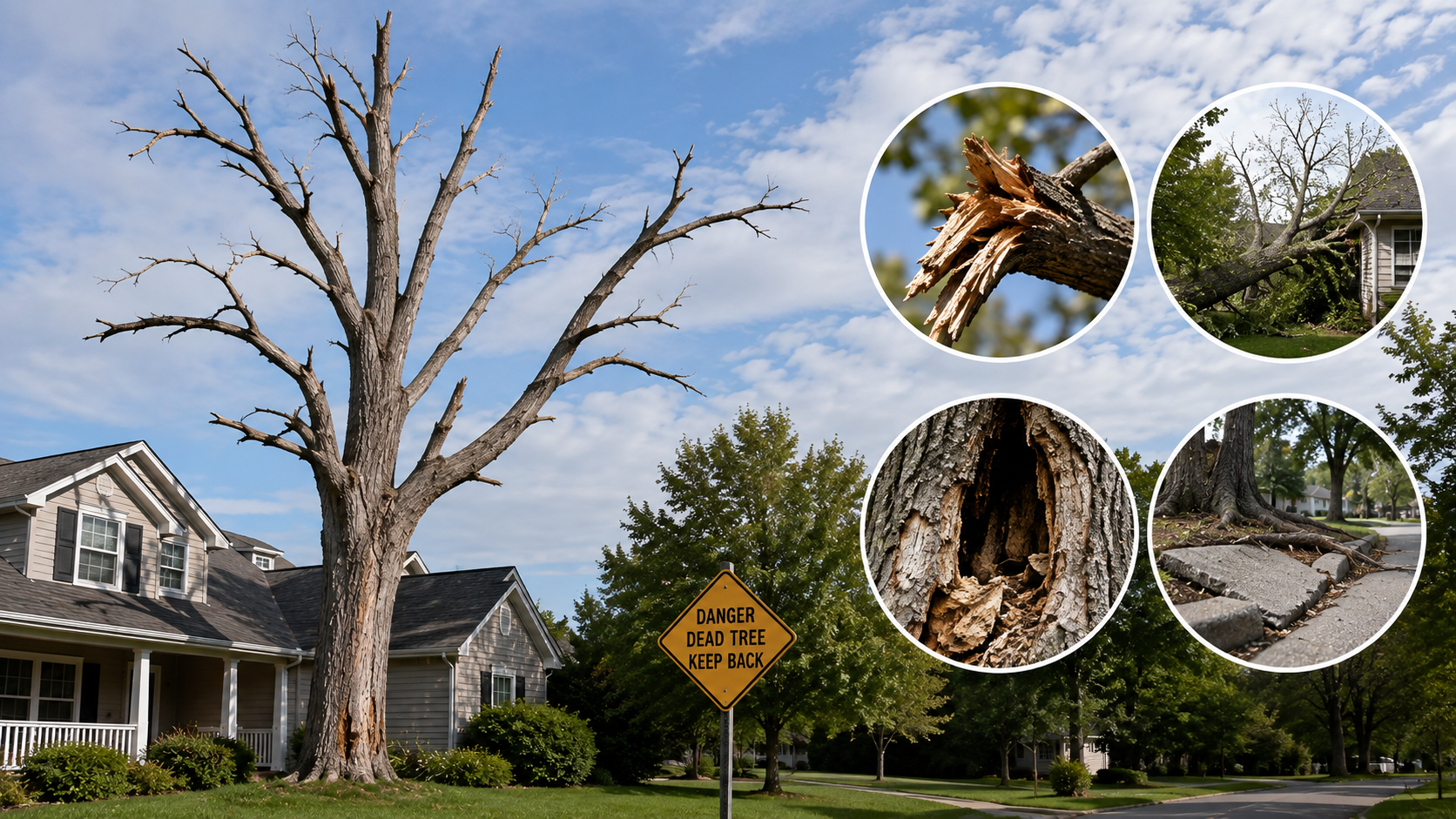
A dead tree does not look immediately dangerous. It stands where it has always stood, often still intact in shape, and the urgency of removing it can be easy to defer when other priorities compete for attention and budget. Many homeowners leave dead trees standing for years, either because removal feels expensive, because the tree is in a back corner of the property where it seems unlikely to matter, or simply because the task keeps getting pushed to next season.
The problem with this reasoning is that a dead tree deteriorates on a timeline that is invisible from the outside. The internal decay that began when the tree died progresses through the wood structure in ways that reduce its structural integrity without changing its external appearance. A dead tree that looked stable last year may be significantly compromised this year, and the failure, when it comes, gives little or no warning.
Quick Answer: The primary risks of leaving a dead tree standing are structural failure leading to falling limbs or the whole tree, property damage to structures, fences, vehicles, and neighbouring property, liability for injuries or damage caused by the failure, pest infestation that can spread from the dead tree to other wood structures, and disease spread to nearby living trees from certain fungal and bacterial pathogens. The longer the tree stands dead, the greater each of these risks becomes.
Structural Deterioration: The Invisible Timeline
When a tree dies, the biological processes that maintained the structural integrity of its wood stop. Living wood is maintained by a continuous cycle of moisture regulation, cellular repair, and growth that keeps the wood fibres strong and flexible. Dead wood begins drying unevenly, which causes internal stresses. Fungal decay organisms that were held in check by the living tree's defences begin breaking down the wood structure from within.
The rate of this deterioration varies by species, moisture conditions, and the specific organisms present, but the direction is always the same: progressive weakening. A freshly dead tree may retain much of its structural strength for a year or two. A tree that has been dead for three or more years may have extensive internal decay that is entirely invisible from the outside while the trunk and major limbs have become genuinely unsafe.
The specific failure mode most associated with dead trees is not a slow lean but a sudden snap: the trunk or a major limb breaks under a load that a living tree would have handled easily, during a wind event, a heavy rain, or simply because a weakened section has reached the point where its own weight exceeds what remains of its structural integrity.
The Liability Dimension
If a dead tree on your property falls and damages a neighbour's structure, vehicle, or fence, or injures a person on or adjacent to your property, your liability exposure depends significantly on whether you knew or should have known the tree was dead or hazardous. A tree that was professionally assessed as dead and left standing represents a known hazard, and the homeowner who delayed removal despite that knowledge is in a very different legal position than one whose tree failed without any prior warning. Professional tree removal records and any prior assessments or recommendations create a paper trail that courts consider directly relevant to liability determinations.
Homeowners insurance covers tree-related damage in some circumstances, but policies typically exclude or limit coverage for damage caused by trees that were known to be dead or hazardous before the failure. The insurer's investigation of a claim will often include reviewing whether the tree had been identified as a problem and whether the homeowner took reasonable action. A tree that was visibly dead for two years before it fell is a difficult claim to defend.
Storm Risk: When Dead Trees Fail Most Often
Dead trees fail most frequently during the conditions that stress all trees: high winds, heavy wet snow, and ice loading. These are also the conditions when falling trees and limbs cause the most damage, because storms that bring these conditions are often accompanied by heavy rainfall that makes the ground soft and reduces the resistance that healthy root systems provide.
While storm damage prevention through regular trimming applies to living trees, a dead tree offers nothing that trimming can address: the structural risk is inherent to the dead wood itself, and the only meaningful risk reduction is removal.
The timing of failure is also unpredictable in a way that makes the deferral logic particularly dangerous. A dead tree does not signal when it is about to fail. It does not lean progressively further in the weeks before collapse. It fails when a sufficient load is applied to a sufficiently degraded structure, and that moment can be a year away or it can be the next significant wind event.
Pest and Disease Risks
A dead tree is a significant pest habitat. Wood-boring beetles, carpenter ants, and subterranean termites are all attracted to the decaying wood of a dead tree, and a dead tree standing close to a structure provides a bridgehead from which these pests can extend their activity toward the building. The pest risk after removal from a stump is meaningful; the pest risk from a full dead tree standing in the yard is substantially greater because the volume of decaying wood available to sustain and grow a colony is much larger.
Disease spread from certain fungal pathogens present in dead wood is also a consideration for specific species. Dutch elm disease, for example, remains active in dead elm wood and is spread by bark beetles that breed in that wood. A dead elm left standing becomes a beetle breeding site from which the disease is actively spread to living elms in the vicinity. Removing and properly disposing of the wood before beetles emerge in spring is the standard management recommendation for confirmed Dutch elm disease cases.
Assessing whether a tree showing signs of internal decay has progressed to the point where removal is the correct course of action is best done by a professional who can evaluate both the structural condition and the species-specific disease and pest risks.
When Removal Becomes Urgent
Some dead tree situations qualify as genuine emergencies rather than scheduled work. A dead tree that is already leaning toward a structure, a dead tree with large cracks in the trunk at a point below major limb junctions, or a dead tree that has already dropped large limbs without obvious cause is a situation calling for emergency tree removal rather than a scheduled appointment weeks away.
The practical test for urgency is proximity and trajectory: if the dead tree were to fall from its current position in any likely direction, what would it hit? A dead tree in the far corner of a large lot with no structures, vehicles, or regular human activity in its fall zone is a lower priority than one standing 20 feet from the house, 10 feet from a parked car, or alongside a path that children use regularly.
Frequently Asked Questions
How quickly does a dead tree become dangerous?
The timeline varies by species, size, moisture conditions, and decay organisms present. In general, a freshly dead tree retains reasonable structural integrity for one to two years. After three or more years, internal decay is typically extensive enough to create significant structural risk. Trees in moist, shaded locations decay faster than those in drier, sunnier positions.
Does a dead tree need to be removed immediately or can it wait a season?
If the tree is not in a fall zone that threatens a structure, vehicle, or area of regular human activity, and if it has been dead for less than a year or two, scheduling removal within the season is generally appropriate rather than emergency removal. If any of those conditions change, the timeline for removal should be accelerated.
Who is responsible if a neighbour's dead tree falls on my property?
Liability depends on whether the tree owner knew or should have known the tree was dead or hazardous before it fell. If you have notified your neighbour in writing that their tree is dead and they have not acted, documenting that notification strengthens your position if the tree later causes damage. An attorney can advise on specific liability questions for your situation.
Can a dead tree be made safe without removing it?
Not in a meaningful long-term sense. Structural support systems (cabling and bracing) are sometimes used to extend the life of a structurally compromised living tree, but they are not appropriate for dead trees where the wood itself is deteriorating. The only reliable risk reduction for a dead tree is removal.
What should I do with the wood from a dead tree after removal?
If the tree died from a disease like Dutch elm disease, the wood should not be stored on the property as firewood or left in a log pile, as disease vectors can overwinter in the bark. For most other species, the wood can be used as firewood once split and seasoned. The stump should be ground to prevent it from becoming a pest habitat.
The Bottom Line
A dead tree standing in a residential yard carries increasing structural, liability, pest, and disease risks as time passes. The risks are invisible from the outside until the moment of failure, and that failure rarely provides warning. Prompt removal after confirming death is the appropriate response in most situations, with urgency proportional to proximity to structures and areas of regular activity.
Sawvell Tree Service assesses and removes dead trees throughout Lake County and the North Shore. If you have a tree you believe may be dead or dying, contact the team for an assessment before the decision is made for you by a storm.