

Does a Tree Stump Attract Termites and Other Pests?
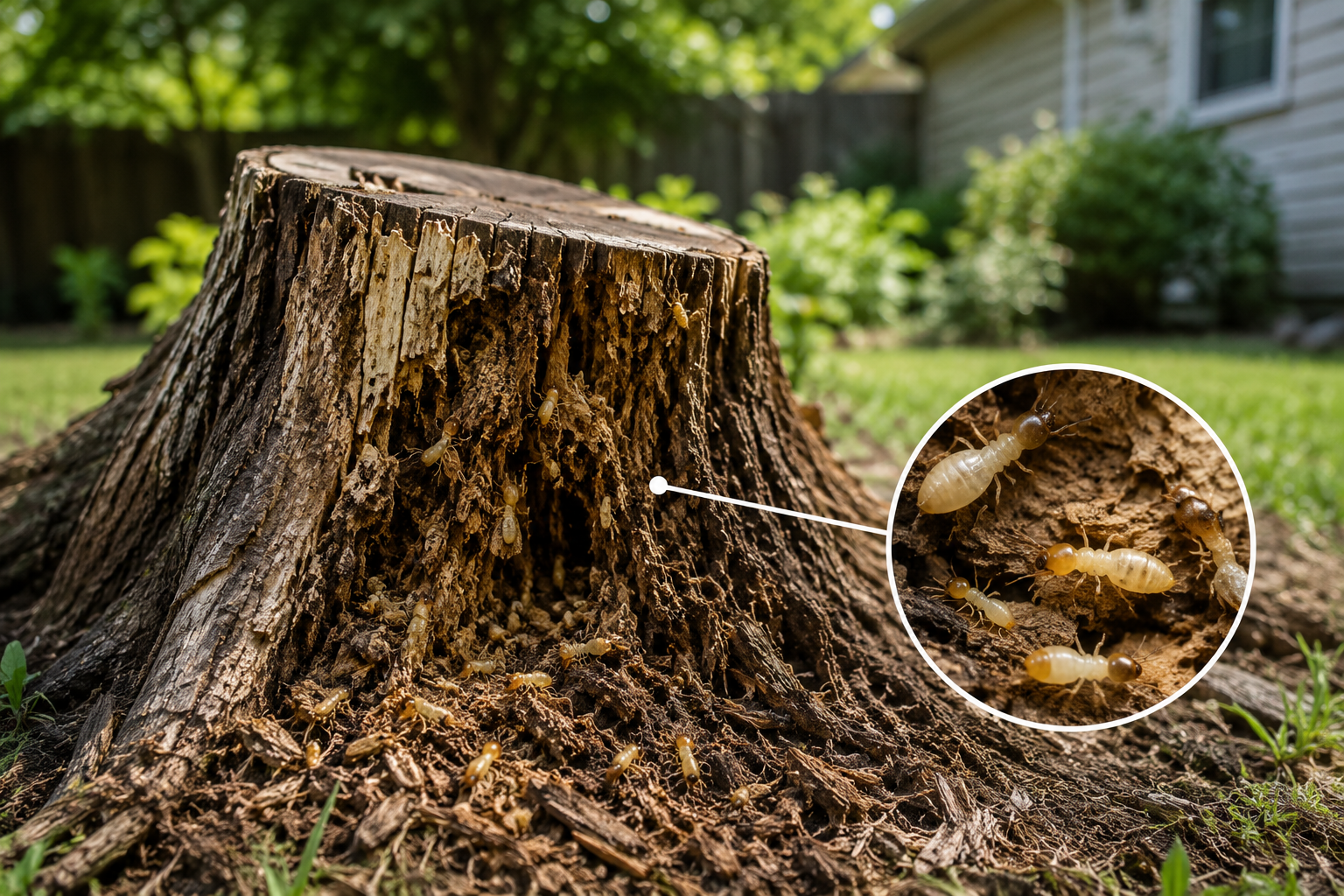
Leaving a tree stump in the yard after a removal is a common choice. The immediate urgency of the removal is over, the stump is not visually dramatic, and the cost of grinding can feel easy to defer. For many homeowners, that deferral stretches from weeks to years, and by the time the stump becomes a problem, the problem has grown considerably larger than the stump itself.
The concern about stumps and pests is not unfounded or exaggerated. A decaying tree stump is genuinely attractive to a range of wood-boring and wood-nesting insects, and some of those insects pose a meaningful risk to other wood structures on the property. Understanding what actually happens inside and around a decaying stump helps homeowners make a more informed decision about whether and when to deal with it.
Quick Answer: Yes, a tree stump can attract termites, carpenter ants, wood-boring beetles, and other pests that are drawn to decaying wood. The stump itself may not be the primary concern: the risk is that colonies established in a stump can spread to fences, sheds, decking, and eventually the main structure of the house. The closer the stump is to the home, the more serious that risk becomes.
What Insects Are Attracted to Tree Stumps
Subterranean termites are the most concerning pest associated with decaying stumps in the Lake County area. These termites live in the soil and forage through wood at or below the soil surface. A decaying stump provides exactly what they need: soft, moist, cellulose-rich wood in or near the ground. Once a termite colony establishes feeding activity in a stump, the colony grows and the foraging range expands.
Carpenter ants are the second most commonly found large-scale pest in decaying stumps. Unlike termites, carpenter ants do not eat wood: they excavate it to create nesting galleries. A stump with softened heartwood from decay is an ideal nesting site. Carpenter ant colonies in stumps can grow large, and satellite colonies from that primary nest can establish in other wooden structures nearby.
Wood-boring beetles, including bark beetles and certain longhorn beetle species, also use decaying stumps as both a food source and a breeding site. Their larvae burrow through the wood and emerge as adults, and while they are less immediately threatening to structures than termites, the presence of large numbers indicates significant decay that supports other pest activity.
The Pathway From Stump to Structure
The most important thing to understand about stump pests is not the insects themselves but the pathway they can take from the stump to other parts of the property. Subterranean termites build mud tubes to travel above ground. A colony in a stump fifteen feet from the house can extend foraging tubes through the soil to reach wood framing, siding, or flooring within a year or two if conditions are favourable.
Carpenter ant colonies that outgrow a stump nest will establish satellite colonies in adjacent sources of moist wood. Fencing, deck framing, and window or door frames that have any moisture intrusion become the next target. The stump functions as the initial colony site from which the broader infestation expands.
The decaying root system connected to the stump creates additional risk below ground. Root decay below the surface provides a pathway through which termites and carpenter ants can travel underground, making them harder to detect until they emerge in an unexpected location.
How Quickly Does a Stump Become a Pest Risk
The timeline from freshly cut stump to active pest habitat varies by species, conditions, and climate. Hardwood stumps, which are denser, take longer to soften than softwood stumps. In Illinois, a freshly cut stump can become actively infested within one to three years as the outer layers begin to decay and attract insects. Within five years, a stump from most common tree species will have measurable pest activity.
Moisture accelerates this process significantly. Stumps in areas with poor drainage, in shade where they stay wet, or in contact with mulch or soil that retains moisture around the base will decay faster and attract pests sooner than stumps in drier, more exposed locations.
Stumps close to the house are the priority concern for exactly this reason. A stump at the back of a large lot, far from any structure, may not pose a meaningful structural risk even as it decays. A stump against a fence attached to the house, within ten feet of the foundation, or adjacent to wood framing is a more immediate concern that warrants earlier action.
Does Removing the Stump Eliminate the Risk
The most effective solution to stump-related pest risk is removing the food source. Stump grinding removes the food source by mechanically destroying the stump to below ground level, producing wood chips that decay rapidly and no longer provide a suitable nesting or feeding substrate for wood-boring insects.
Understanding the difference between stump grinding and stump removal is relevant here: stump grinding addresses the visible stump and the root flare to a depth of several inches below the surface, which is sufficient to eliminate the primary habitat. Full stump removal extracts the root ball entirely, which is a more significant undertaking and is rarely necessary purely for pest management purposes.
If a stump has already developed an active termite infestation, grinding the stump should be paired with a pest inspection and, if necessary, soil treatment around the stump area. Grinding alone disrupts the colony and removes the primary food source, but a large established colony in the soil may need targeted treatment to be fully addressed.
Signs That a Stump May Already Be Infested
Several visible signs suggest a stump has developed pest activity. Mud tubes on the outer surface of the stump, particularly at ground level, indicate subterranean termite activity. Sawdust-like frass around the base of the stump is a sign of carpenter ant or wood-boring beetle activity. Soft, spongy wood when the stump is pressed or probed indicates advanced decay that supports extensive pest habitation.
Keeping an eye on root activity in the surrounding soil can also reveal pest-related issues: disturbed soil near root lines, particularly soft areas or areas where the grass has died back, can sometimes indicate underground feeding activity from a stump-based colony.
After the stump is ground, the area can be filled, seeded, or prepared for new planting. Many homeowners replant after stump grinding within a few months once the wood chip material from the grinding has settled and begun to decompose.
Frequently Asked Questions
How close does a stump need to be to the house to pose a termite risk?
Subterranean termites can forage from a stump to a structure up to 50 to 100 feet away under favourable soil conditions, though risk increases significantly the closer the stump is to the house. Stumps within 20 feet of the foundation warrant more urgent attention than those at the far edge of the property.
Can I treat a stump to prevent pests without removing it?
Chemical treatments, such as stump treatments with nitrogen or fungicides, can slow decay and reduce the hospitable conditions for some insects. These are partial measures at best and do not eliminate the risk as effectively as physical removal. For stumps close to structures, removal is the more reliable solution.
Will mulching or covering a stump make the pest problem worse?
Yes. Covering a stump with mulch or soil traps moisture and accelerates the decay that attracts pests. Mulch directly against a stump also provides a bridge that makes it easier for termites and carpenter ants to move between the stump and other wood in the landscape. Keeping mulch several inches away from stumps and wood structures is standard pest management advice.
Do all tree species attract the same pests?
Some species are more attractive to specific pests than others. Oaks, elms, and most hardwoods can harbour subterranean termites and carpenter ants as they decay. Softwoods like pine and spruce tend to decay faster and attract beetles and carpenter ants more quickly, but termites will use any decaying wood near their colony.
How much does stump grinding cost in Lake County?
Stump grinding in Lake County typically ranges from $150 to $400 per stump depending on stump diameter, depth required, and site access. Multiple stumps on the same property usually cost less per stump than a single standalone grind due to equipment mobilisation efficiencies.
The Bottom Line
A tree stump left in the yard does attract termites, carpenter ants, and wood-boring beetles as it decays, and stumps near structures pose a genuine risk of pest migration that can extend to fencing, decking, and the main house. The closer the stump to any wood structure, the more urgently it should be addressed.
Sawvell Tree Service provides stump grinding throughout Lake County and the North Shore. If you have a stump that has been in the yard for a few years, or one that is close to your house, reaching out for an assessment is a sensible step.