

Why Are Termites Attracted to Old Stumps and Fallen Trees?
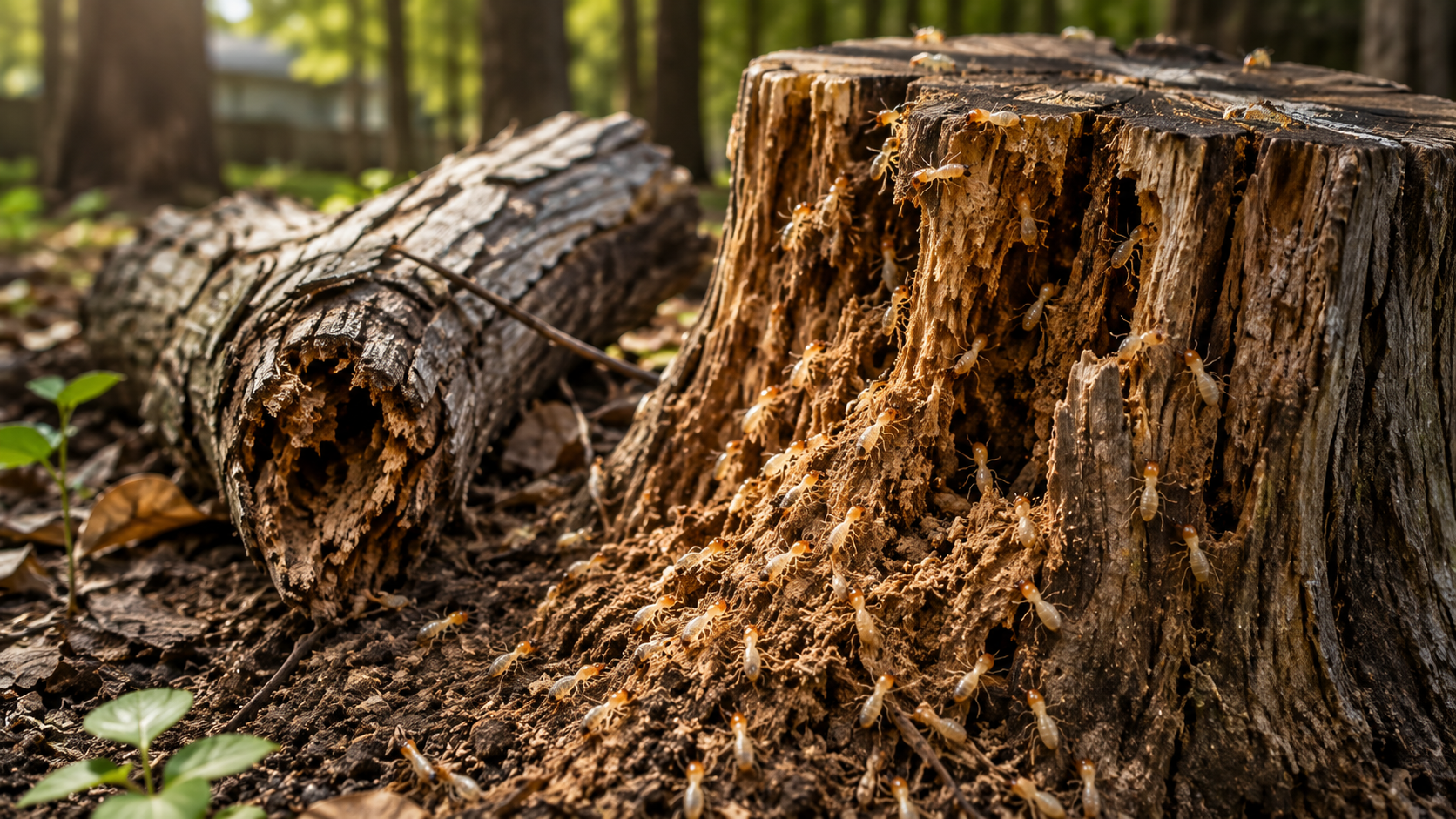
Termites are one of the most ecologically important organisms in any forest ecosystem: they are decomposers, breaking down dead wood and returning its nutrients to the soil in a process that takes decades by other means. In a natural forest setting, this is enormously valuable. In a suburban yard, the same biological programme plays out in the dead wood that happens to be present, and when that dead wood is close to a home, the termite colony that establishes in it has the potential to extend its activity toward the structural wood of the building.
Understanding why old stumps and fallen trees attract termites so reliably requires understanding what termites are actually looking for. They are not drawn to wood in general: they are drawn to specific conditions that exist in decaying wood, and those conditions become more attractive, not less, as the wood ages. A freshly cut stump and a five-year-old decaying stump are not equally attractive to termites, and understanding why reveals what makes the management of these wood sources genuinely important.
Quick Answer: Termites are attracted to old stumps and fallen trees because decaying wood provides the combination of moisture, cellulose, and softened wood structure that subterranean termites need to feed and establish colonies. Fresh wood is harder to penetrate and less palatable; aged, decaying wood has been softened by fungal activity, has higher moisture content, and offers easy access to the cellulose that termites digest. The closer this decaying wood is to a structure, the higher the risk that an established colony will extend its foraging toward the building.
What Termites Are Actually Looking For
Subterranean termites, the species responsible for most structural wood damage in Illinois, live in colonies in the soil and forage through wood at or near the soil surface. They need three things from a food source: cellulose (the structural component of wood that they can digest with the help of gut microorganisms), moisture (which they cannot generate internally and must obtain from their food and environment), and access (they cannot penetrate very hard, dry, intact wood efficiently).
A freshly cut stump provides cellulose but is relatively hard and its moisture content drops as it dries in the first months after cutting. As the stump ages and fungal decay organisms begin breaking down the wood structure, all three conditions improve: the wood softens and becomes easier to penetrate, moisture is retained more effectively as the cellular structure breaks down, and the fungal activity itself produces chemical compounds that termites are attracted to as signals of a suitable food source.
The Role of Fungal Decay in Termite Attraction
This is the mechanism that most people do not know about: termites are not simply looking for wood. They are particularly attracted to wood that is already being worked on by decay fungi. The chemical signals produced during fungal decomposition of wood, specific compounds released as the wood structure breaks down, act as attractants for termite scouts searching for new food sources.
This means the most attractive stump or fallen tree for termite colonisation is not a fresh one but one that has been in place long enough for decay to establish. A stump that has been in the yard for three or four years, visibly beginning to soften and possibly already showing fungal fruiting bodies on its surface, is actively signalling its suitability as a food source to any termite scouts in the surrounding soil.
The practical implication is that the urgency for removing stumps and fallen trees from areas near the home increases with time rather than decreasing. A homeowner who planned to deal with a stump eventually and left it for five years has created a significantly more attractive termite habitat than the one they started with.
How Colonies Move from Stump to Structure
Subterranean termites build mud tubes that allow them to travel from their soil colony to food sources while maintaining the humidity they need to survive. These tubes are typically constructed along the soil surface, across concrete, and up through cracks in foundation walls. From a stump or fallen tree, a colony's foraging range extends in all directions through the soil.
The risk to a structure comes when a stump or fallen tree close to the building provides the food source that sustains colony growth to the point where foraging activity naturally extends to the building itself. Termites do not travel from a stump to a house because they are seeking the house specifically: they travel because the colony's food requirements grow as the colony grows, and the building's structural wood is simply the next cellulose source that the expanding foraging network encounters.
Distance and Proximity: How Close Is Too Close
Subterranean termites can forage from a colony food source to a new target over distances of 50 to 100 feet under favourable soil conditions. This means a stump at the edge of an average suburban lot is not safely remote from the house purely by virtue of its distance. Stumps within 30 feet of a structure represent meaningfully elevated risk, and stumps within 10 to 15 feet of a foundation are in a range where termite activity in the stump should be considered a direct structural threat.
The specific soil conditions and moisture levels in the yard also affect how readily termites travel. Moist, organic-rich soil that retains moisture supports easier termite movement than dry, sandy soil. A stump in a shaded, moist part of the yard in close proximity to the house is the most concerning combination.
Fallen Trees: Often More Urgent Than Stumps
A fallen tree presents a termite risk that is in some ways more urgent than a standing stump because it lies in direct contact with the soil along its full length. The soil contact provides moisture and allows immediate access for subterranean termites without the need to build upward from ground level. A large fallen tree decomposing across a yard can sustain a substantial termite colony across the full length of its contact zone.
Fallen trees are also more difficult to fully address: cutting them into sections for removal is straightforward for the above-ground portions, but ensuring that all the bark and below-grade wood at each former contact point is removed or treated requires thoroughness that is easy to overlook when the visible portions of the tree are gone.
What to Do About Stumps and Fallen Trees
The most effective management for stumps that may attract or already harbour termites is removal of the food source. Stump grinding destroys the stump to below grade level, removing the bulk of the above-ground and near-surface decaying wood that provides the most accessible and attractive termite habitat.
The broader context of stumps and pest attraction covers the full range of wood-boring and wood-nesting insects that decaying stumps support, of which termites are the most structurally consequential but not the only concern.
If termite activity is already present in a stump, grinding the stump removes the primary food source and disrupts the colony, but an established colony in the surrounding soil may not be fully addressed by stump removal alone. A pest control professional should assess whether soil treatment is warranted in addition to the physical removal of the wood source.
Understanding stump removal options helps homeowners decide whether grinding to below grade is sufficient for their situation or whether complete root ball extraction is warranted based on the extent of pest activity and the proximity to the structure.
Frequently Asked Questions
How can I tell if a stump or fallen tree already has termites?
Look for mud tubes on the surface of the stump, particularly at ground level. Termites construct these pencil-width tunnels of soil and wood particles to travel between their colony and their food source. Also check for small piles of frass (which looks like sawdust) near the base, soft areas that yield when pressed, and any visible damage to the wood surface that has a honeycomb or tunnelled interior appearance.
Does mulch made from a termite-infested tree spread termites?
Chipping the wood into small mulch pieces destroys the habitat that termites need to survive in the wood itself. The termites in the colony, which live in the soil rather than the wood, are not transported in the chips. However, wood chips laid in thick layers against a building's foundation can retain moisture and provide conditions that attract termites from soil colonies already present in the yard. Keeping mulch at least 6 inches from the foundation is standard pest prevention advice.
Are all termites in Illinois subterranean termites?
In Northern Illinois, subterranean termites are the species responsible for the overwhelming majority of structural damage. Drywood termites, which infest dry wood and do not require soil contact, are not typically established in the Northern Illinois climate. Subterranean termite management is the relevant concern for most Lake County homeowners.
If I remove the stump, will the termites go away?
Removing the food source disrupts the colony and reduces its food supply, but an established colony in the surrounding soil does not disappear when the stump is removed. The colony may forage to other wood sources or, if the food supply reduction is severe enough and the colony is young, decline over time. For mature colonies or for stumps that are close to a structure, a professional pest assessment after stump removal is sensible.
How long after a tree is cut does it take for termites to find the stump?
Subterranean termites can begin exploring a new food source within weeks of it becoming available if an active colony is already foraging in the surrounding soil. The stump becomes progressively more attractive over months to years as decay softens the wood. Active infestation of a freshly cut stump can occur quickly in a yard with existing termite pressure; a stump in a yard without current termite activity may take years to attract a new colony.
The Bottom Line
Termites are attracted to old stumps and fallen trees because decaying wood provides exactly the conditions they seek: moisture, softened cellulose, and the chemical signals produced by fungal decomposition. The longer a stump remains, the more attractive it becomes, and the closer it is to a structure, the more directly that attraction translates into structural risk.
Sawvell Tree Service provides stump grinding and fallen tree removal throughout Lake County and the North Shore. If you have decaying wood near your home and want to reduce pest risk, reach out for a professional assessment and removal estimate.