

How Far Should Tree Branches Be from a House?
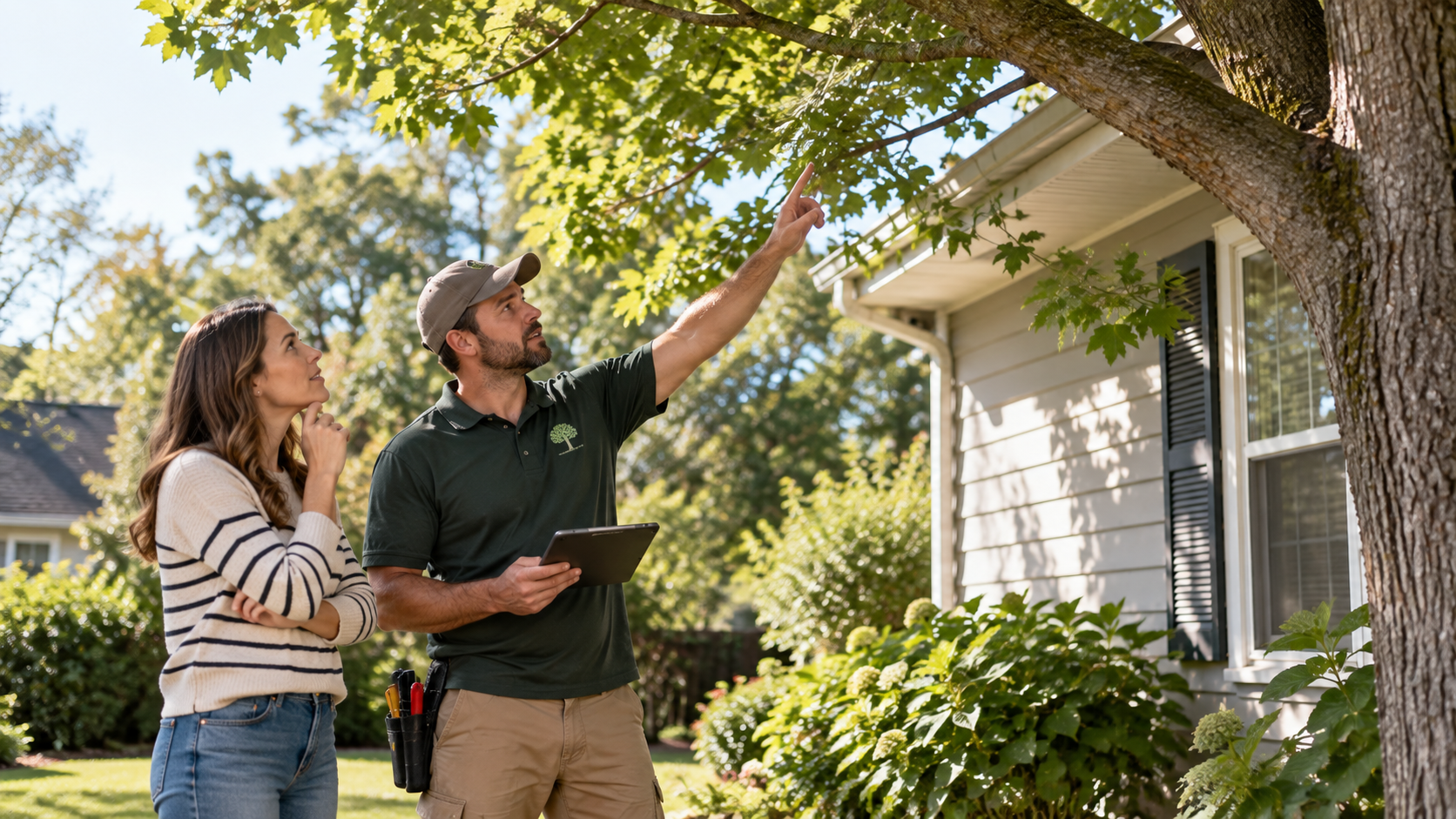
Large trees can make a home feel established, shaded, and connected to the landscape. The same canopy can become a maintenance concern when branches grow toward the roof, siding, gutters, windows, chimney, or nearby utility lines. Clearance matters because a branch does not need to fall completely to cause damage. Repeated rubbing, falling twigs, trapped moisture, and heavy limbs moving in a storm can all create problems over time.
The right distance is not identical for every tree. Species, branch size, roof height, wind exposure, tree condition, and the way the limb is attached all affect the decision. A small flexible branch near a wall is different from a large overextended limb above a bedroom or garage. The goal is to create useful clearance without stripping too much foliage or making cuts that weaken the tree.
Quick Answer: Tree branches should not touch or rub against a house, and a practical target is often about 6 to 10 feet of clearance from the roof and siding when the tree structure allows it. Larger, heavier, fast-growing, or defect-prone limbs may need more space. The safest distance is based on the individual tree, so branches over a home should be assessed rather than cut back to one universal measurement.
How Much Clearance Should Tree Branches Have From a House?
For many residential trees, keeping several feet of open space between live branches and the building is a sensible maintenance goal. About 6 to 10 feet gives room for seasonal growth and normal movement in wind without constant contact with the roof or wall. The exact amount should be adjusted for how quickly the species grows and how large the branch could become before the next pruning cycle.
Clearance is most important around roofs, gutters, chimneys, siding, windows, and places where people regularly walk or park. professional tree trimming can shorten or remove selected limbs while keeping the overall canopy as natural and balanced as possible. The objective is not to create a sharp empty wall around the house. It is to guide growth away from the structure and reduce avoidable contact.
If a mature tree already extends over the roof, it may not be realistic or healthy to remove every overhanging branch in a single visit. A certified arborist can look at branch size, attachment, decay, canopy balance, and species tolerance before recommending how much clearance can be created safely.
Why Is It a Problem When Branches Touch the Roof or Siding?
Branches that touch a building can cause damage gradually. Wind moves the canopy back and forth, so even a branch that seems harmless on a calm day can scrape roofing materials, paint, trim, or siding during storms. Leaves and small twigs can also collect in roof valleys and gutters, holding moisture and slowing drainage.
The greater concern is a heavy branch with enough size to damage the structure if it fails. A limb does not have to be dead to break. Included bark, old wounds, decay, weak unions, storm injury, excessive end weight, or an unbalanced canopy can increase the chance of failure. Sawvell Tree Service uses tree inspection and storm prep to identify these concerns before severe weather exposes them.
A branch hanging over a home deserves more attention than the same branch over an open lawn because the target below changes the consequence of failure. That does not mean every overhanging branch is dangerous. It means the branch should be evaluated for condition, weight, attachment, and clearance rather than judged only by whether it crosses the roofline.
Is Six to Ten Feet a Rule for Every Tree?
No. Six to ten feet is a useful planning range, not a universal arboricultural rule. A young ornamental tree may be managed with less clearance because its limbs are small and easy to direct. A large oak, maple, or other mature shade tree may require a more conservative plan because removing a large amount of live canopy at once can stress the tree and create large pruning wounds.
Clearance also depends on what part of the house is nearby. Branches around a chimney, roof edge, second-story wall, balcony, or service line may need different treatment. If the tree is growing toward utility conductors, homeowners should not try to create clearance themselves. Tree work around energized lines requires specialized training and coordination.
The best plan balances two goals: protecting the structure and preserving sound tree architecture. That is why a good pruning prescription identifies specific branches and cut locations instead of simply telling a crew to remove everything within a certain radius.
How Should Branches Be Pruned Away From a Building?
Branches should generally be reduced or removed at appropriate branch unions rather than cut at arbitrary points. Reduction pruning can shorten a limb by bringing it back to a suitable lateral branch, which helps redirect future growth and leaves a more natural canopy. Small branches may be removed entirely when that creates better long-term structure.
Sawvell Tree Service describes its tree pruning services as including structural pruning, deadwood removal, hazard limb removal, and clearance trimming around homes and driveways. Those methods are more useful than topping, which cuts branches back indiscriminately and can trigger weak sprouts, large wounds, and poor structure.
Pruning should also respect the tree as a whole. Removing too much foliage from the house side can leave a lopsided canopy and shift weight away from the trunk. On mature trees, it may be better to create clearance in stages rather than force the entire objective in one season.
What Signs Mean a Branch Near the House Needs Prompt Attention?
A branch does not need to be touching the house to deserve attention. Visible defects can make a limb more urgent, especially when the branch is positioned over a roof, driveway, patio, or entrance.
Dead or leafless wood that is not consistent with the season
Fresh cracks, splits, or hanging branches after wind or snow
Large cavities, decay, or fungal growth near a branch union
Branches that have begun rubbing the roof, chimney, siding, or windows
Heavy limbs with long reaches and little support beneath them
A sudden lean, soil movement, or root plate lifting near the trunk
If a limb has already split, fallen, or become suspended over the structure, keep people away from the area and use a professional emergency tree service. Storm-damaged wood can move unpredictably, and a partly attached branch may be under significant tension.
When Is Trimming Not Enough to Solve the Problem?
Sometimes the issue is larger than branch clearance. A tree may be severely declined, structurally unstable, repeatedly damaging the building, or positioned so close that normal growth will create the same conflict again and again. In those cases, an arborist may compare preservation options with professional tree removal.
Removal should not be the automatic answer just because a tree is close to a house. Healthy mature trees provide shade, privacy, character, and landscape value. The better question is whether the tree can be managed safely and sustainably. If repeated heavy pruning would be needed to keep the tree away from the structure, removal and replacement with a better-sited species may eventually be the more practical choice.
Very large trees close to homes can require controlled sectional work instead of conventional felling. In tight spaces, crane assisted removal can allow sections to be lifted away from roofs, garages, fences, and landscaping rather than dropped into a limited fall zone.
How Often Should Branch Clearance Be Checked?
Check branches around the house at least once or twice a year and after major wind, ice, or snow events. A quick visual review can catch new contact with the roof, deadwood, split limbs, or growth that has entered a problem area. Fast-growing trees may need more frequent attention than slow-growing mature trees.
Professional pruning intervals vary. Some trees benefit from regular structural work every few years, while others may need only occasional maintenance. Local conditions matter as well. Sawvell provides North Shore tree care for properties with mature trees, tight clearances, valuable landscaping, and large branches near homes and outdoor living spaces.
The most efficient approach is preventive. Waiting until a branch is lying on the roof turns routine maintenance into a repair or emergency problem. Early pruning usually allows smaller cuts, better structure, and more options for preserving the tree.
Who Should Evaluate Large Branches Over a House?
A professional tree assessment is especially useful when the branch is large, high, difficult to access, or attached near a visible defect. An arborist can evaluate the tree as a living structure instead of focusing only on the branch closest to the roof. That broader view can reveal whether pruning, monitoring, support, treatment, or removal is the better long-term choice.
Sawvell Tree Service offers a range of professional tree care services across Lake County, the North Shore, and nearby communities. For homeowners, the useful starting point is a site-specific look at the tree, the house, and the space between them. That makes the clearance recommendation practical for the property rather than based on a number alone.
Frequently Asked Questions
These are common questions homeowners ask when branches begin growing toward a roof, wall, or other part of the house.
Can tree branches touch a roof without causing damage?
It is better not to let branches rest on or repeatedly rub a roof. Wind movement can scrape roofing materials, and leaves or twigs can collect moisture and block drainage. Even small branches should be redirected before contact becomes routine.
Should every branch overhanging a house be removed?
No. A healthy, well-attached branch can sometimes extend over part of a house without being an unacceptable risk. Its size, condition, attachment, clearance, and the tree species should be assessed before deciding whether to reduce or remove it.
How far should branches be from a chimney?
More clearance is usually appropriate around a chimney than around an ordinary wall because of heat, debris, and fire concerns. Local building and fire guidance may also apply, so the exact distance should be checked for the property.
Can I trim branches near the roof myself?
Small branches reachable safely from the ground may be simple to maintain, but climbing, ladder work, chainsaws, heavy limbs, and branches near power lines should be left to trained professionals. The risk increases quickly once a branch is large enough to damage the home or move unpredictably when cut.
Will branches grow back toward the house after trimming?
Yes, many trees will continue growing into available space. Proper reduction and directional pruning can guide future growth, but clearance still needs periodic inspection and maintenance as the tree matures.
Conclusion
Tree branches should stay clear of the house, with roughly 6 to 10 feet often serving as a practical residential target when the tree can be pruned that way safely. The right amount of clearance depends on branch size, tree health, species, growth rate, and what part of the home is below or beside the canopy.
Sawvell Tree Service can assess branches near roofs, siding, driveways, and other structures and recommend pruning that protects both the property and the tree. A free estimate is an easy next step if the canopy is getting too close for comfort.