

What Is the Difference Between Tree Pruning and Tree Trimming?
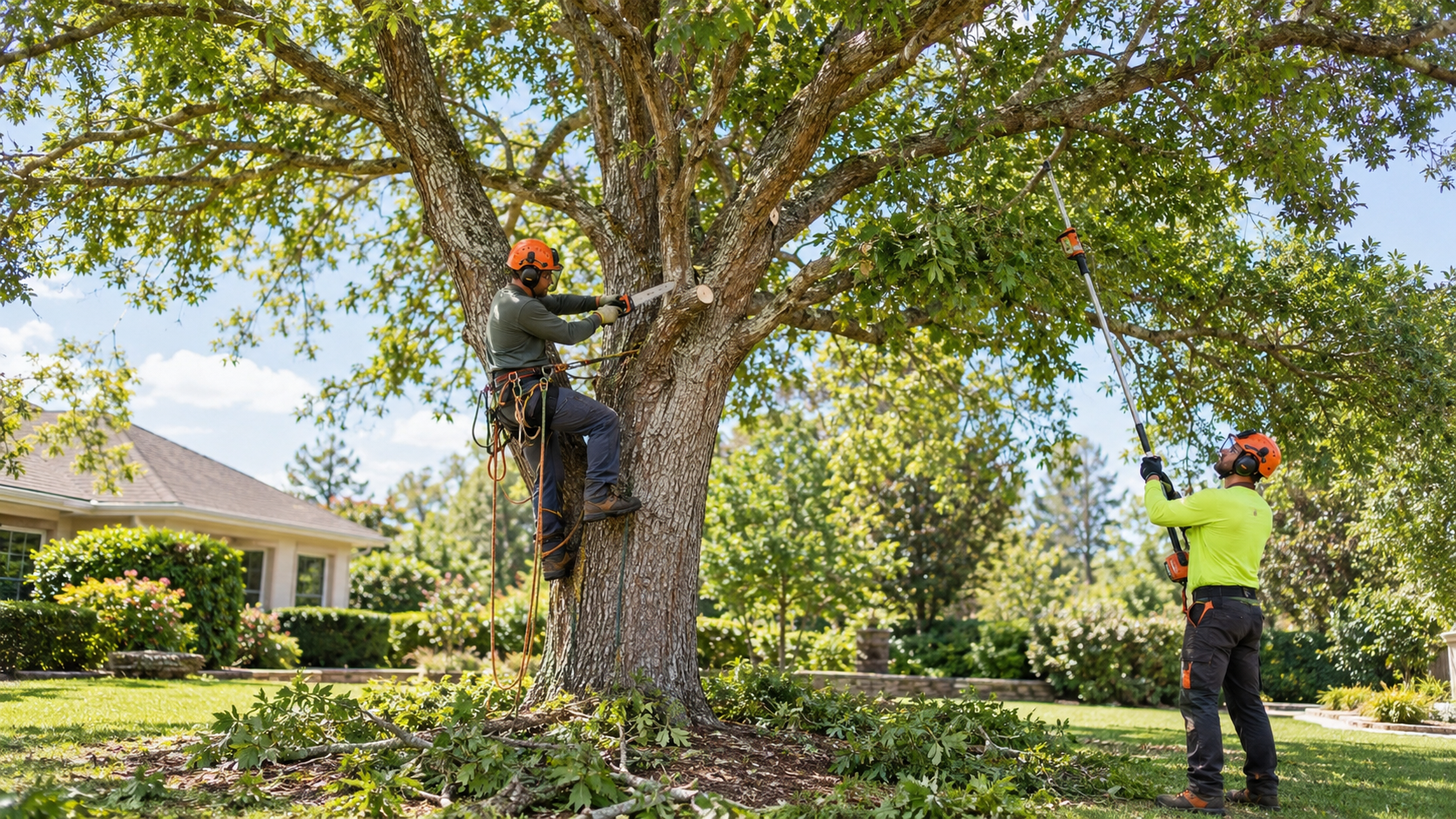
Pruning and trimming are two of the most common terms in tree care, and many people use them as if they mean exactly the same thing. Even tree companies often list them together, which adds to the confusion.
The difference matters when you are deciding what your trees actually need. One focuses mostly on shape and clearance, while the other focuses on the health and structure of the tree, and knowing which one to ask for helps you get the right result.
Quick Answer: Tree pruning is the selective removal of specific branches to improve a tree's health, structure, and safety, such as cutting out dead, diseased, or weak limbs. Tree trimming usually means cutting back overgrowth to control size, shape, and clearance. In practice, professional tree work often combines both.
What Is Tree Pruning?
Pruning is targeted and selective. An arborist chooses individual branches to remove based on how each cut will affect the tree's growth, strength, and long-term health.
Common pruning goals include removing dead or diseased wood, correcting weak branch attachments, and improving air and light flow through the canopy. Pruning young trees builds a strong structure early, which reduces problems as the tree matures.
What Is Tree Trimming?
Trimming generally refers to cutting back growth to manage a tree's size and appearance. It is often done to keep branches away from roofs, driveways, walkways, and power lines, or to maintain a neat shape.
The term is also widely used for shrubs and hedges, where regular shearing keeps plants tidy. For trees, trimming tends to focus on clearance and overall form rather than individual branch health.
How Do Pruning and Trimming Compare?
The two overlap, but their main purpose is different. Here is a simple way to compare them:
• Purpose: pruning targets health and structure, while trimming targets size, shape, and clearance.
• Method: pruning removes selected branches, while trimming cuts back overgrowth more broadly.
• Timing: routine pruning is often best during dormancy, while clearance trimming may happen whenever growth becomes a problem.
• Expertise: pruning decisions benefit most from an arborist's knowledge of tree biology.
Both rely on proper cutting technique. Poor cuts, such as topping or leaving long stubs, can invite decay and weaken the tree over time.
What Pruning Techniques Do Arborists Use?
Professional pruning uses several standard techniques, often combined in a single visit. Crown thinning selectively removes branches to open the canopy, improve airflow, and reduce wind resistance.
Crown reduction lowers a tree's height or spread while keeping its natural shape. Other techniques include deadwood removal, structural pruning on young trees, and crown raising, which removes lower limbs to clear walkways, driveways, and views.
When Should You Prune or Trim Your Trees?
Most trees benefit from professional care every 1 to 3 years, depending on species, health, and location. Late fall through early spring is generally ideal for routine work, since dormant trees experience less stress and their structure is easier to see.
Some trees have special timing needs. Fruit trees and shade trees often follow different schedules, so pruning fruit trees versus shade trees calls for slightly different plans. In Illinois, oaks should not be pruned in spring and early summer because of the risk of spreading oak wilt.
Hazardous limbs are the exception. Dead, cracked, or hanging branches should be removed as soon as they are found, regardless of the season.
Does Pruning or Trimming Hurt a Tree?
Done correctly, pruning helps a tree by removing weak and unhealthy wood and directing growth where it is needed. Proper trimming helps a tree grow stronger rather than harming it.
Problems come from over-pruning and poor technique. Removing too much of the canopy at once stresses the tree, and improper cuts can damage or even kill it. Industry standards such as ANSI A300 guide professional pruning practices for this reason.
Frequently Asked Questions
Is tree trimming the same as pruning?
Not exactly. Pruning focuses on removing specific branches for health and structure, while trimming usually means cutting back growth for size, shape, and clearance. Many people use the terms interchangeably, and professional work often includes both.
Which is better for my tree, pruning or trimming?
It depends on the goal. Pruning is best for health, safety, and structure, while trimming is best for clearance and appearance. An arborist can recommend the right mix for each tree.
How often should trees be pruned?
Most trees benefit from pruning every 1 to 3 years, depending on species, growth rate, health, and proximity to structures. Young trees often need more frequent structural pruning.
What is tree topping, and is it bad?
Topping cuts large branches back to stubs to reduce height. It is widely discouraged because it weakens trees, encourages decay, and leads to fast, weakly attached regrowth.
Can I prune my own trees?
Homeowners can often handle small, low branches with proper tools. Large limbs, high work, and branches near power lines or structures should be left to trained professionals.
Conclusion
Tree pruning is selective work focused on health, structure, and safety, while tree trimming focuses on size, shape, and clearance. Most trees benefit from a combination of both, done with proper technique and at the right time of year.
Sawvell Tree Service provides arborist-guided tree trimming and pruning across Lake County, the North Shore, and the Northwest Suburbs, with a certified arborist on staff. If your trees are due for care, request a free estimate from the team.