

Do Large Leaning Trees Always Need Professional Removal In Lake County?
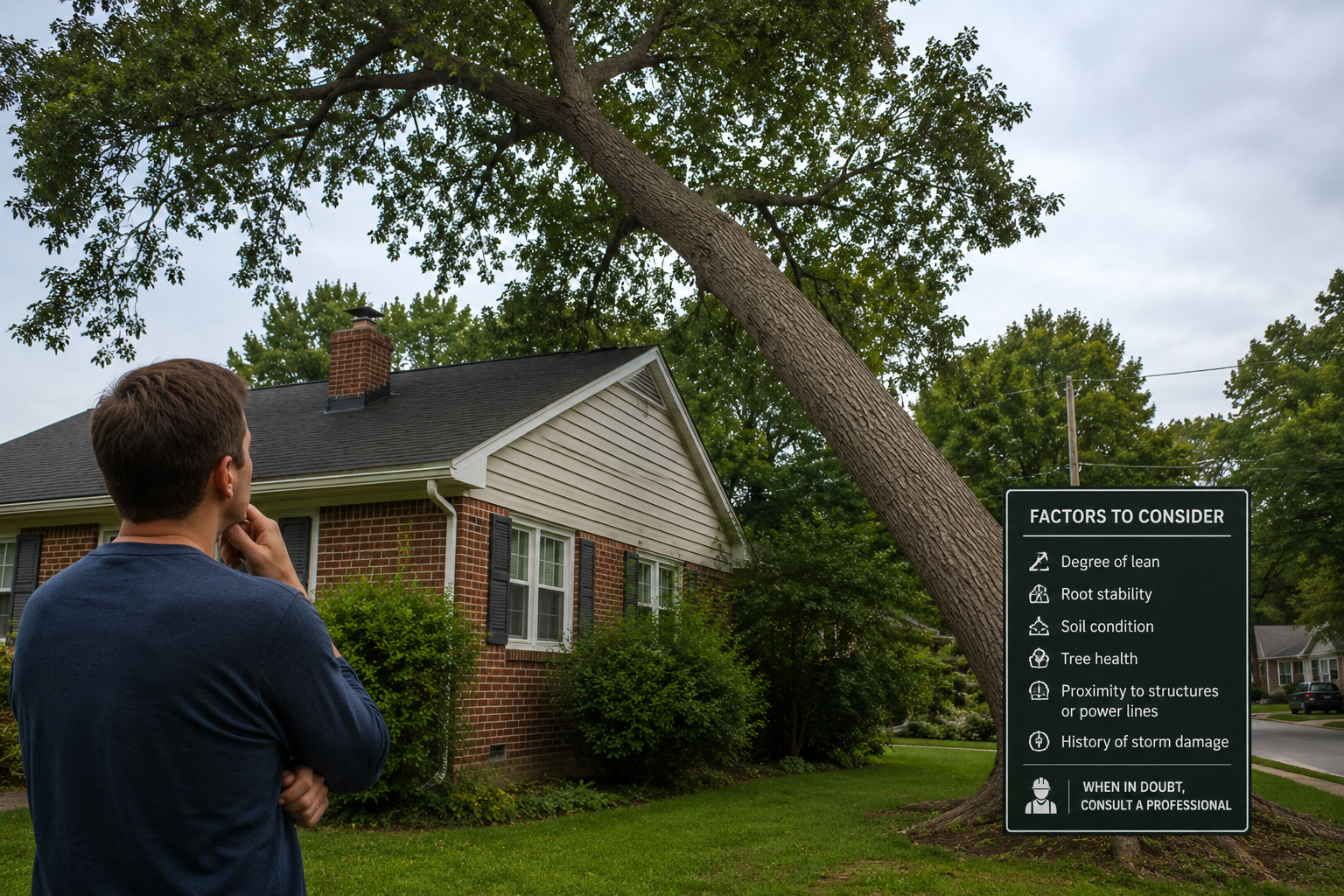
A large leaning tree in the garden or along the property line is one of those things that sits in the back of a homeowner's mind. On a calm day it looks fine. When a storm rolls through, it suddenly becomes the primary focus of attention. The questions that come up are predictable: is this actually dangerous? Does it need to come down? Or is the lean just part of how the tree grew?
These are reasonable questions, and the honest answer is that lean alone is not an automatic signal for removal. Trees grow at angles for all kinds of reasons, and many leaning trees are structurally sound and will stand for decades without incident. What matters is the nature of the lean, what is causing it, how it relates to nearby structures, and whether the tree shows any additional signs of structural compromise.
Quick Answer: Not all large leaning trees require removal. Trees that have grown with a consistent lean over many years and show healthy root structure, no decay, and no progressive change are often stable and do not pose an elevated risk. However, a lean that has developed recently, is increasing over time, is accompanied by soil heaving at the base, or involves a tree with known decay or root damage warrants urgent professional assessment. Some leaning trees can be stabilised with cabling; others genuinely need to come down.
Natural Lean Versus Developing Lean
The distinction between a tree that has always leaned and a tree that is leaning progressively is the most important initial assessment any homeowner can make. A tree that has occupied the same angle for as long as anyone can remember has typically developed root and wood structure that compensates for the lean. Its internal anatomy has adapted to the load, and the root plate anchors it accordingly.
A tree that has begun to lean more noticeably in recent months or years, or one that shifted suddenly after a storm or an event like a period of very wet weather, is telling you something different. That kind of change is evidence that something has altered in the relationship between the tree and the ground beneath it, and that warrants attention quickly rather than monitoring.
What to Look for at the Base
The most revealing place to look when assessing a leaning tree is the ground immediately around the base on the side opposite the direction of lean. If the root plate is beginning to lift, you will see cracking or heaving of the soil, sometimes forming a curved ridge as the roots tear free from the ground. This is a serious warning sign that the tree is actively losing its anchoring and may fail in the next significant wind event.
Soil heaving at the base combined with a recent increase in lean is probably the clearest indication that a tree needs professional attention without delay. By comparison, a tree whose base shows no disturbance, whose root flares look healthy and symmetrical, and whose lean has been unchanged for years is unlikely to need urgent intervention.
The presence of internal decay changes the calculation significantly. A tree that is leaning toward a structure and shows signs of decay in the trunk or major roots is far more dangerous than an equally leaning tree with sound wood throughout, because the decayed wood cannot withstand the mechanical stress that the lean places on it.
When Cabling Is an Option
For trees where the lean is caused by crown imbalance rather than root or trunk compromise, cabling and bracing can provide supplemental structural support that reduces the risk of failure without requiring removal. This approach works by installing high-strength cables in the upper crown to redistribute the load and limit movement in high wind conditions.
Cabling is not a permanent fix for all leaning situations, and it is not appropriate for trees with significant root or trunk problems. But for trees with a sound structure that happen to be asymmetrically weighted, it can meaningfully extend their safe lifespan and reduce the liability associated with a tree growing near a structure or property line.
The condition for cabling to work as a solution is that the tree itself is otherwise healthy and structurally sound. An arborist assessing a leaning tree for cabling is looking for the absence of decay, a healthy root zone, and a lean that is attributable to growth pattern rather than structural failure.
When Removal Is the Right Answer
Some leaning trees genuinely do need to come down. A large tree that is leaning significantly toward a house, that has been gaining angle, that shows soil disturbance at the base, or that has significant decay in the trunk or major limbs represents a real risk to property and safety. The cost of damage if such a tree fails is typically far higher than the cost of removing it under controlled conditions.
Removing a leaning tree is more complex than removing one that is growing vertically. The lean itself introduces a direction of preferred failure, and the cutting sequence must account for this to prevent the tree from moving unexpectedly during the work. Assessing structural hazard before removal is important precisely because the nature of the hazard affects how the removal should be planned and executed.
Trees that have been stressed by root zone stress from drought or repeated flooding can develop progressive lean as the root structure weakens without any visible surface symptoms, which is one reason that a tree that looked stable during a dry period can surprise homeowners when heavy rain saturates the soil and reduces its grip on a weakened root plate.
The Role of a Professional Assessment
The safest approach for any large leaning tree near a structure is to have it evaluated by a certified arborist who can assess root structure, wood condition, the nature of the lean, and proximity to targets before making a recommendation.
A visual assessment by a trained professional can identify warning signs that a homeowner would miss: subtle changes in the root flare, bark anomalies that suggest decay, the sound of hollow wood when tapped, and the presence of fungal growth that indicates significant internal deterioration. These details often determine whether a tree is a genuine risk or simply one that looks concerning from a distance.
Frequently Asked Questions
Is a tree that has always leaned safe?
Generally yes, provided the lean has been consistent for many years, the root zone shows no disturbance, and there is no visible decay. Trees that grow at an angle develop compensating wood structures that support the lean. The key is consistency: a lean that is not changing and is associated with a healthy, well-anchored root system is typically stable.
How much lean is too much for a large tree?
There is no single number that defines 'too much' lean. The combination of factors matters more than the angle alone: a tree at 15 degrees with decayed roots and soil heaving is far more dangerous than a tree at 25 degrees with a sound root system and no change over many years. A professional assessment is more informative than trying to measure the angle.
Can a leaning tree be straightened?
Young, newly planted trees can sometimes be staked and straightened. Mature trees that have developed their lean over years cannot be safely straightened because their root architecture has formed to support the existing angle. Attempting to cable-pull a large tree upright is more likely to cause root damage than to achieve the goal.
Does a tree leaning over my neighbor's property create legal liability?
Potentially yes. If a tree owner is aware that their tree poses a risk to an adjacent property and takes no action, they may bear responsibility for any resulting damage. Getting a professional assessment and acting on it appropriately is the most practical protection against this kind of liability.
How quickly can a leaning tree fail?
This varies enormously. A tree with active root plate lifting can fail in the next significant windstorm. A stable leaning tree with sound structure might stand indefinitely without intervention. The urgency depends on the specific condition of the tree, which is why professional assessment rather than observation from a distance is the appropriate response to any tree that raises concern.
The Bottom Line
Large leaning trees are not automatically dangerous, but they deserve a professional look rather than a wait-and-see approach, particularly when they are close to structures. The difference between a stable leaning tree and a genuinely hazardous one is often visible to an experienced eye but not to an untrained one.
Sawvell Tree Service provides assessments for leaning trees and hazardous tree conditions across Lake County and the North Shore. If you have a tree that concerns you, a site visit is the most reliable way to understand what you are actually dealing with.