

How Do Tree Cabling and Bracing Help Rescue Weak Limbs?
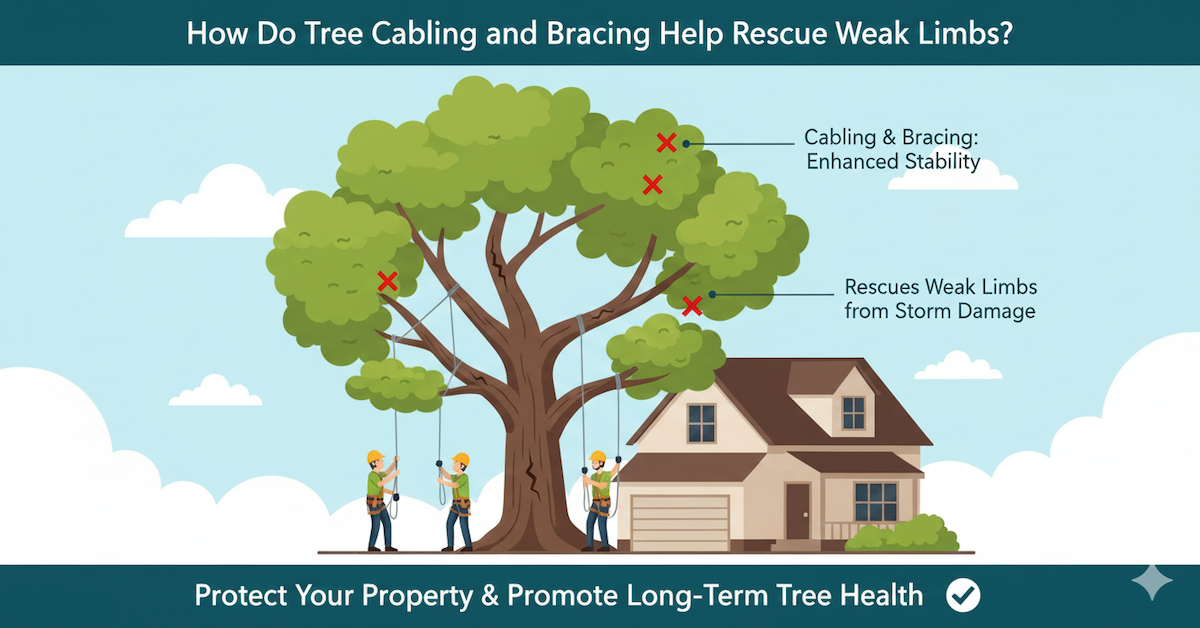
Trees often develop weak or stressed limbs that need extra support to stay healthy. Heavy branches, poor branch angles, storm damage, and natural aging can all create structural problems that put the tree and your property at risk. Instead of removing large limbs or cutting down the entire tree, many of these issues can be corrected through cabling and bracing. These support systems strengthen the tree and help prevent limb failure, allowing the tree to grow safely for many more years.
Cabling and bracing are widely used in both residential and commercial tree care. They are reliable, minimally invasive, and effective for rescuing compromised limbs. Homeowners often do not realize that these systems can save a valuable tree that might otherwise need to be removed. Understanding how the process works makes it easier to decide whether your tree might benefit from this type of support.
Quick answer: Tree cabling and bracing help rescue weak limbs by adding structural support. Cables reduce excessive movement in the canopy, while braces reinforce cracked or splitting sections. Together, they stabilize the tree and reduce the risk of falling branches.
Why Trees Develop Weak or Failing Limbs
Many factors cause tree limbs to weaken over time. Some branches grow too long or too heavy for the trunk to support. Others develop narrow branch angles that create stress points where splitting can occur. Storms can crack limbs or bend them into unstable positions. In some cases, decay inside the branch makes it more likely to break.
These conditions often go unnoticed until the limb begins to sag, split, or show visible cracks. When homeowners see these warning signs, they may assume the limb needs to be removed entirely. In reality, many trees can be saved if the weak limb is supported properly before it fails. Cabling and bracing offer a way to strengthen the tree without removing healthy growth.
How Cabling Provides Flexible Support for Tree Canopies
Cabling is used to limit excessive movement in the upper canopy. When wind pushes a heavy limb, the motion can cause the branch to crack or break. By installing high strength steel cables between major limbs, arborists reduce the amount of sway the limb experiences. This support system helps distribute weight more evenly and keeps the limb secure during storms.
Cables are typically installed high in the tree because this is where leverage is greatest. The cable is anchored with bolts drilled into strong, healthy wood. Arborists carefully tension the cable to allow natural movement while preventing dangerous overextension. The goal is not to immobilize the tree but to guide its movement in a safer, controlled way.
Cabling is often used for multi trunk trees or trees with large horizontal limbs that extend over homes, driveways, or yards. It is also helpful for older trees that need support to maintain their natural shape. When installed properly, cabling can extend a tree’s life and prevent severe storm damage.
How Bracing Strengthens Weak or Cracked Branches
Bracing offers more rigid support than cabling. Instead of controlling movement, braces reinforce the physical structure of the tree. Bracing rods are inserted through weak or splitting areas to hold the limb together. This is commonly used when a branch shows signs of cracking at the junction where it meets the trunk.
Unlike cabling, bracing is designed to restrict movement. This prevents a weakened branch from widening or worsening a split. Bracing is often paired with cabling so the limb receives both internal reinforcement and upper canopy stability. When used together, these two systems give the tree the best chance of recovery and long term health.
When Cabling and Bracing Are Necessary
Cabling and bracing are recommended when a limb shows signs of weakness but still has enough healthy tissue to survive. It is often used for trees that hold sentimental or landscape value, such as shade trees or mature ornamentals. These systems are also helpful when a limb hangs over structures that could be damaged if it breaks.
Arborists evaluate the tree’s overall condition before recommending support. If the decay is too advanced or the structure is too compromised, removal may be the safer option. But in many cases, cabling and bracing allow a homeowner to preserve a tree that would otherwise be considered unsafe.
Caring for Trees After Cabling and Bracing
Once the support systems are installed, trees need periodic inspection to ensure everything remains secure. Cables should be checked for proper tension, and braces should be examined for any signs of movement or wear. Pruning may also be recommended to reduce weight on the supported limb and improve airflow throughout the canopy.
Healthy maintenance helps the tree adapt to its reinforced structure and recover over time. Many trees continue to grow successfully for decades after receiving support, especially with regular care and monitoring.
Conclusion
Cabling and bracing are effective ways to rescue weak or damaged tree limbs without removing the entire tree. These systems restore strength, reduce movement, and prevent future breakage. By adding structural support at key points, arborists can preserve the beauty and shade of mature trees while protecting your property from falling branches. For homeowners who value their trees, cabling and bracing offer a practical and long lasting solution.
If you suspect a limb on your property is weakening or showing signs of stress, Sawvell Tree Service can provide a professional evaluation. Their experienced team installs reliable cabling and bracing systems designed to protect both the tree and your home, helping your landscape stay safe and healthy for years to come.