

What Does a Certified Arborist Do That a Regular Tree Cutter Doesn't?
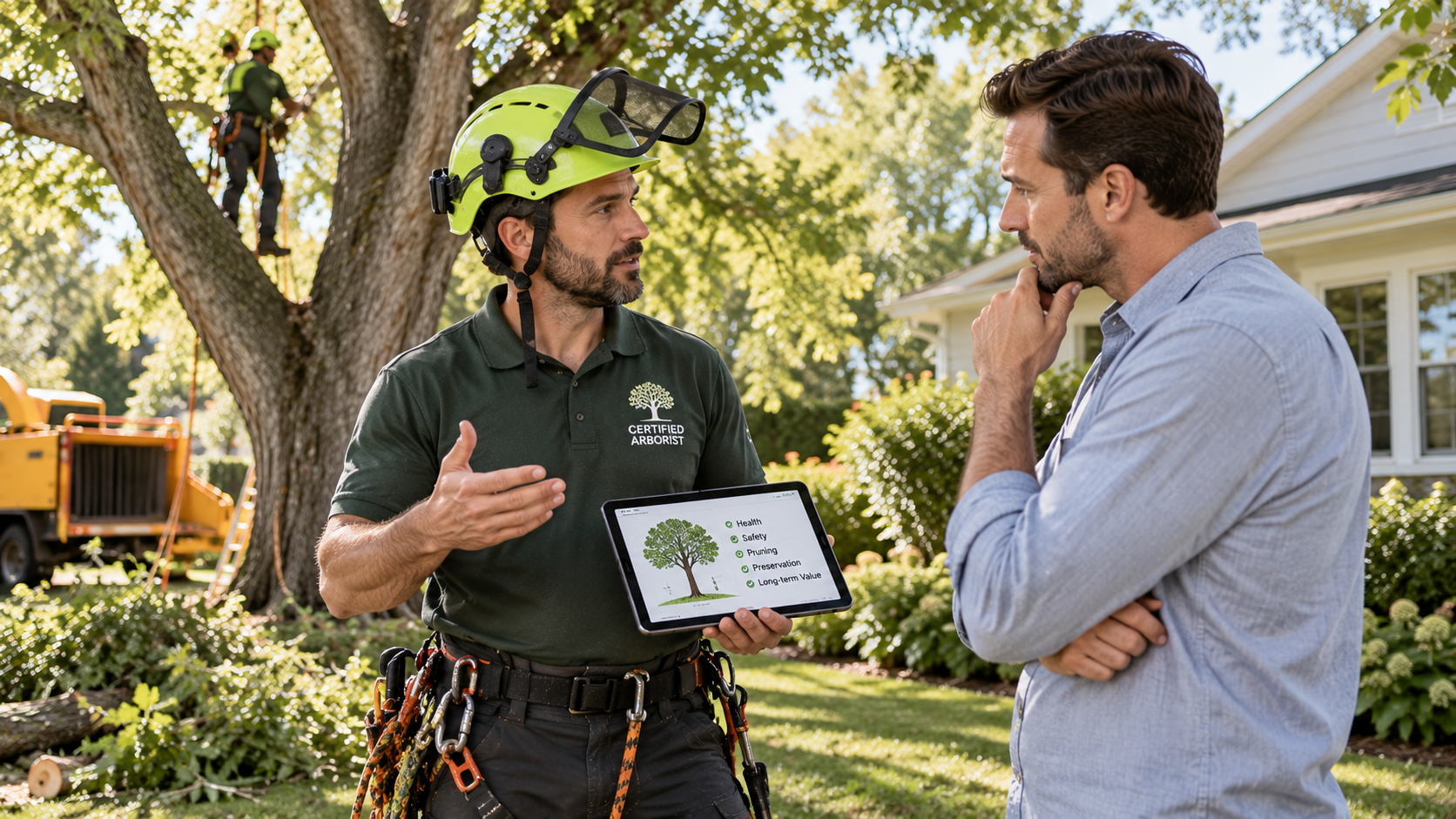
Most homeowners can see when a branch needs to come down, but tree care often involves questions that are harder to judge from the ground. Is a thin canopy caused by disease, root stress, storm damage, or normal seasonal change? Is a leaning tree unstable, or has it grown that way for decades? Can a large limb be reduced safely, or will the cut create a bigger structural problem later?
Those questions explain the difference between cutting wood and managing a living tree. A skilled tree worker may be excellent at climbing, rigging, operating equipment, and completing removals. A certified arborist adds formal arboricultural knowledge that helps diagnose problems, evaluate risk, plan pruning, consider preservation, and recommend work based on tree biology rather than cutting alone.
Quick Answer: A certified arborist is trained and tested in tree biology, identification, pruning, health, soil and root issues, risk, and long-term care. A regular tree cutter may be able to remove branches or trees safely, but certification provides a documented knowledge standard for deciding what should be cut, what should be preserved, and why. The best tree work combines sound arboricultural judgment with an experienced field crew.
What Does Certified Arborist Actually Mean?
A certified arborist has earned a professional arboriculture credential rather than simply using the job title. The International Society of Arboriculture certification program requires relevant experience or education, a passing examination, and continuing education to maintain the credential. The exam covers multiple areas of tree care, not just pruning or removal.
Sawvell Tree Service has a certified arborist on staff and highlights arboricultural knowledge in tree identification, health, and pruning. That matters because many problems look similar from a distance. Leaf loss, branch dieback, cracks, fungal growth, or poor vigor can have very different causes and different management options.
Certification does not mean that every job requires a laboratory-style diagnosis. It means the person making recommendations has a structured base of knowledge and is expected to keep that knowledge current.
How Is an Arborist Assessment Different From Simply Cutting a Branch?
A branch can be removed quickly, but the important question is whether removing it helps the tree and the property. An arborist looks at branch attachment, canopy balance, species response, trunk condition, nearby targets, and the size of the wound that would be created. The recommendation may be to remove the branch, reduce it, monitor it, or leave it alone.
That approach is visible in professional tree trimming that uses structural pruning, deadwood removal, hazard limb removal, and clearance work instead of indiscriminate cutting. Good pruning keeps enough foliage to support the tree while improving structure and reducing specific conflicts.
A cutter focused only on making the canopy smaller may solve the immediate clearance problem but create weak regrowth or large wounds. Arboricultural pruning tries to solve the reason for the cut while preserving a stable framework for future growth.
Can a Certified Arborist Diagnose Tree Health Problems?
An arborist can evaluate visible symptoms and site conditions to narrow down likely causes of decline. The process may include tree species, leaf and twig symptoms, bark condition, root flare, soil conditions, recent construction, drainage, insects, disease signs, and the pattern of dieback across the canopy.
That does not mean every problem can be confirmed from one visual visit. Some issues require sampling, laboratory testing, or observation over time. The value of the arborist is knowing which symptoms matter, what additional information is needed, and whether treatment is practical.
This is particularly important when a valuable tree looks stressed but is not necessarily unsafe. Removing it too early sacrifices a mature landscape asset, while ignoring a serious decline can leave the property exposed to branch or whole-tree failure.
How Does an Arborist Decide Whether a Tree Should Be Removed?
Removal is usually considered when the tree is dead, structurally unsound, severely declining, creating unacceptable risk, or permanently incompatible with the site. The arborist weighs condition against the target below the tree. A defect over an open field is different from the same defect over a house, playground, driveway, or busy walkway.
When removal is appropriate, tree removal service can be planned around access, nearby structures, equipment, and cleanup. Large trees may need sectional rigging, aerial access, or a crane rather than conventional felling.
An arborist can also explain when removal is not yet necessary. Monitoring, selective pruning, treatment, or changing the area around the roots may provide a reasonable preservation path. That distinction is one of the clearest differences between tree care and tree cutting.
What Does an Arborist Look for in Tree Risk?
Tree risk is not based on one visible flaw. The assessment considers the likelihood of a branch or tree failing, the likelihood that it will strike something important, and the likely consequence if it does. That means both the tree and the property layout matter.
Common concerns include deadwood, cracks, weak unions, decay, cavities, root damage, sudden leaning, soil movement, storm injury, and heavy branches extending over targets. A proactive storm tree inspection can identify defects before strong wind, snow, or ice adds extra load.
If a tree has already failed or become unstable, the priority changes from diagnosis to making the site safe. Sawvell provides emergency tree response for fallen trees, hanging limbs, storm damage, and trees threatening homes or access areas.
Why Does Tree Biology Matter During Pruning?
Trees respond to cuts rather than healing them the way skin heals. They grow new tissue around wounds and isolate damaged areas internally. Cut size, cut location, season, species, tree vigor, and the amount of foliage removed all influence how the tree responds.
An arborist uses that knowledge to avoid unnecessary large cuts, protect branch collars, maintain canopy balance, and choose pruning methods suited to the objective. For example, reducing a long limb back to a suitable lateral branch is usually more sustainable than cutting it at an arbitrary midpoint.
This matters most on mature trees, where a single large cut can remain visible for years and may become a pathway for decay. The aim is to achieve clearance or risk reduction with the least harmful set of cuts.
Does Certification Matter During Large or Difficult Removals?
Certification is most valuable in the planning and decision process, while safe removal also depends on the skill of climbers, riggers, equipment operators, and ground crews. Large tree work is a team job. The arborist may help define the safest objective, and the crew executes it using appropriate equipment and work practices.
For confined sites, crane assisted removal allows large sections to be lifted away from homes, garages, driveways, and landscaping. The benefit comes from combining good planning with people who understand rigging, load control, access, and site protection.
After the tree is down, stump grinding service can address the remaining base so the area is easier to restore. An arborist may also advise on replacement planting so the next tree fits the site better at mature size.
Is Every Good Tree Worker a Certified Arborist?
No, and certification should not be used to dismiss experienced tree workers. Many excellent climbers, equipment operators, and removal specialists build deep practical skills over years in the field. Their ability to rig a limb safely or manage a difficult removal is essential.
The difference is that certification verifies a defined body of arboricultural knowledge. It gives homeowners more confidence that recommendations about pruning, health, preservation, and risk are being made from a professional tree care framework. The strongest service combines both sides: arborist-guided decisions and an experienced crew capable of carrying out the work safely.
Sawvell presents that combination across its full tree service range, which includes trimming, removal, crane-assisted removal, stump grinding, emergency work, and arborist support.
When Should You Specifically Ask for an Arborist?
Ask for an arborist when the decision is not obvious or the tree is valuable enough that you want to avoid unnecessary removal. This includes unexplained decline, repeated branch failure, a major crack, root disturbance after construction, a tree leaning toward a structure, disease concerns, or a mature tree that needs substantial pruning.
· You are unsure whether a tree is hazardous or simply large
· A mature tree is losing branches or thinning unexpectedly
· Several treatment or pruning options are possible
· Construction or grading has changed the root zone
· The tree has high landscape, shade, privacy, or sentimental value
· You want a long-term care plan instead of a one-time cut
On wooded or mature properties, North Shore arborist guided care can be particularly useful because tree decisions often involve tight clearances, established landscaping, and canopies that affect several parts of the property at once.
Frequently Asked Questions
These questions help separate the arborist role from the physical work of cutting, climbing, and removing trees.
Is a certified arborist the same as a tree surgeon?
The terms are sometimes used loosely, but certified arborist refers to a specific professional credential when the certification is identified. Tree surgeon is a general job description and does not by itself confirm a particular credential.
Can a certified arborist remove trees?
Yes, arborists may participate in or supervise removals, depending on their field role and skills. The credential itself focuses on arboricultural knowledge, while safe removal also requires appropriate equipment, climbing, rigging, and crew experience.
Can an arborist save every sick tree?
No. Some trees are too damaged, decayed, diseased, or structurally compromised to preserve safely. A good arborist should explain when treatment is realistic and when removal is the more responsible option.
Why should I use an arborist for pruning?
Pruning changes the tree permanently. An arborist can select cuts based on structure, species, health, clearance, and future growth so the work solves a problem without removing more canopy than necessary.
How often should a mature tree be inspected?
There is no single interval for every tree. Mature trees near homes or busy areas should be checked regularly and after major storms, with more frequent professional review when defects, decline, or recent site changes are present.
Conclusion
A certified arborist does more than decide where to cut. The role combines tree biology, identification, health, pruning, risk, site conditions, and long-term planning so homeowners can make informed choices about preserving, treating, pruning, or removing a tree.
Sawvell Tree Service has a certified arborist on staff and an experienced crew for the work that follows the assessment. If you are unsure what a tree actually needs, starting with an arborist-guided evaluation can prevent unnecessary work and clarify the safest next step.