

Can Tree Roots Cause Cracks in Driveways or Foundations?
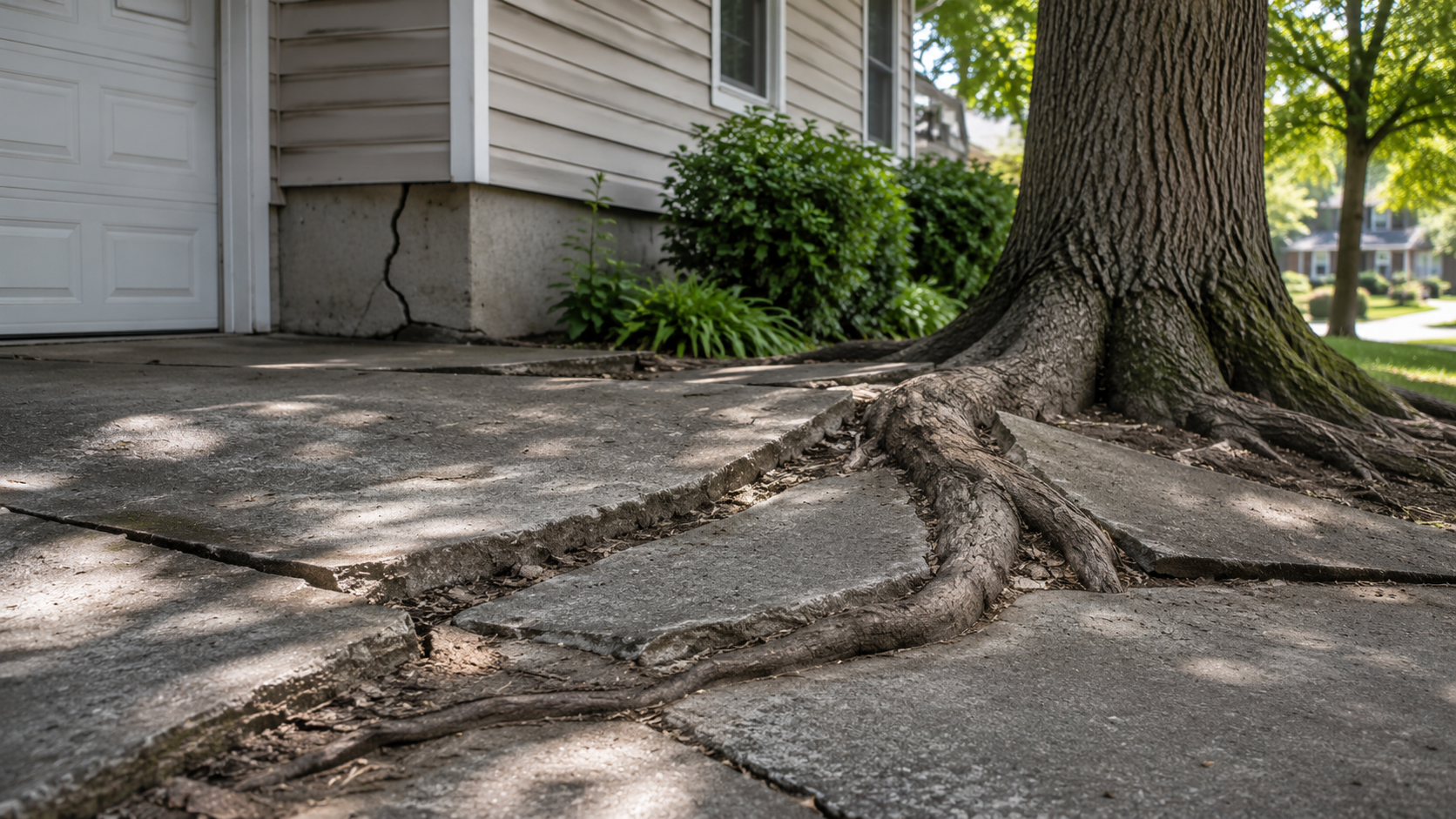
Mature trees are one of the most valuable features a property can have. They provide shade, character, and significant aesthetic and financial value to the landscape. But when a mature tree is growing close to a driveway, a path, or the house itself, questions about what the roots are doing underground are entirely reasonable. The visible surface of a concrete driveway cracking and lifting is one of the most common tree-related property concerns homeowners contact arborists about.
The relationship between tree roots and hardscape or foundations is real, but it is also more nuanced than the straightforward picture of roots physically breaking concrete. Understanding how roots actually behave underground, which tree species create the most risk, and what the distance thresholds are helps homeowners make better decisions about existing trees and new planting choices near structures.
Quick Answer: Yes, tree roots can cause cracks in driveways, and in some circumstances can affect foundations, though foundation damage directly attributable to tree root growth is less common than homeowners often assume. Roots cause driveway cracking primarily by growing underneath slabs and generating upward pressure as they expand. Foundation effects are more typically indirect, caused by moisture extraction from clay soils that causes shrinkage and settlement rather than by physical root penetration of the foundation itself.
How Roots Crack Driveways and Paths
The mechanism is straightforward. Tree roots grow where conditions favour them: in the loose, moist soil beneath a concrete slab or paved surface. As those roots thicken and expand over years, they generate upward pressure that the relatively thin concrete of a residential driveway cannot resist indefinitely. The slab cracks, lifts, and eventually becomes uneven enough to be a trip hazard or a drainage problem.
The proximity of the tree to the paved area matters, but so does the species. Species with aggressive, shallow root systems, particularly willows, silver maples, poplars, and some elms, have a well-documented history of driveway and path damage. More moderate species with deeper root systems cause significantly less disruption to adjacent hardscape, and a tree that is well clear of paving may cause no issues at all.
The age and size of the tree also matters. A young tree planted near a driveway may show no impact for decades before the root system reaches a size where it begins to exert meaningful pressure. The same tree at 40 years old, with a significantly expanded and thickened root system, is a different situation.
Foundation Effects: What the Evidence Shows
Foundation damage from tree roots is a more complicated story than driveway damage. Physical root penetration of a sound concrete or masonry foundation is relatively rare and typically requires an existing crack or weakness for roots to exploit. Roots do not, in most cases, have the mechanical force to break through intact concrete of foundation thickness.
What is more common, particularly in areas with clay-heavy soils, is the indirect effect of moisture extraction. Tree roots in clay soils draw significant moisture from the ground as part of normal water uptake. During dry periods, this causes the clay to shrink and contract, which can cause differential settlement in structures built on those soils. The foundation does not crack because a root pushed it: it cracks because the ground beneath it moved.
This distinction matters because it affects both the assessment of risk and the remediation approach. A tree that is causing differential settlement through soil moisture extraction is a different problem from a tree whose roots are visibly growing beneath a foundation wall, and the solutions are different.
Understanding the signs that roots are already causing damage requires looking at a combination of factors: visible root growth near the affected area, the species of tree, soil type, proximity, and the pattern of any cracking or movement.
Distance as a Factor
A general rule of thumb among arborists is that tree roots extend to a radius approximately equal to the height of the tree, sometimes beyond. A 50-foot oak can have roots extending 50 or more feet from the trunk in all directions. This means that a tree that appears to be a safe distance from a driveway on the surface may have roots running beneath it for years before they become thick enough to cause visible damage.
Planting distance recommendations for trees near hardscape and foundations typically suggest keeping aggressive species at least 20 feet from any paved surface and at least 15 feet from foundation walls. For moderate species, 10 to 15 feet from paving is often cited as a workable minimum, though local soil conditions and the ultimate size of the specific tree modify these guidelines.
When to Get Professional Involvement
If driveway cracking is visible and a mature tree is nearby, a professional assessment can establish whether the root system is the direct cause before any expensive remediation is considered. Professional root removal is sometimes the appropriate response when a specific root section can be removed without compromising the structural stability of the tree. Done incorrectly, root cutting damages the tree and can create additional risks.
Root barrier installation, which places a physical barrier between the root system and the structure to redirect root growth, is another option for trees that are worth preserving but need to be managed in relation to adjacent hardscape. The above-ground impact of overgrown trees is often considered alongside the root situation when making decisions about how to manage a large mature tree near structures.
In some cases, whether the tree needs to come down is the more relevant question when both above-ground and below-ground factors are creating problems that cannot be adequately managed any other way.
After Tree Removal
When a tree that has been causing driveway or hardscape damage is removed, the stump and root system remain. Roots from a removed tree can continue to decay for years underground, and the decay process can cause settling in the soil above. Stump grinding removes the above-ground portion and grinds the stump below the surface level, but it does not eliminate the existing root system. The roots will decay over several years, which generally does not cause structural problems but can produce slight settling in the adjacent ground.
For driveways that have already been lifted or cracked by root growth, simply repairing the surface without addressing the root cause will result in the same damage recurring within a few years. The repair needs to account for the root situation, whether through root cutting, barrier installation, or tree removal, before the surface is reinstated.
Frequently Asked Questions
Which tree species are most likely to damage driveways?
Willows, silver maples, poplars, cottonwoods, and certain elm species are consistently identified as the highest-risk species for hardscape damage due to their aggressive, shallow, moisture-seeking root systems. Oak, beech, and many fruit tree species are generally lower risk for adjacent hardscape.
How can I tell if my tree roots are under my driveway?
The most reliable indicator is cracking or lifting of the slab in an arc or pattern that radiates from the direction of the tree. Visible surface roots near the driveway edge that disappear beneath the surface suggest the root system is extending under the pavement. A professional assessment can confirm this with more certainty.
Can I cut tree roots to protect my driveway without harming the tree?
Sometimes yes, but it requires careful assessment. Cutting roots close to the trunk can significantly destabilise the tree and create safety risks. Generally, root cutting is safer when the cut is made at a distance of at least three times the trunk diameter from the trunk. A certified arborist should assess the specific situation before any root cutting is carried out.
Should I plant trees near my foundation?
Not large species, and not close. For most residential situations, a minimum of 15 to 20 feet between a large tree and the foundation is a sensible starting point, with more aggressive species kept further away. Smaller ornamental trees and shrubs with non-invasive root systems can be planted closer without significant risk.
Does removing the tree stop the root damage?
Removing the tree stops new root growth and halts the expansion of existing roots. However, existing roots will decay in place over several years. If the root-related cracking is going to be repaired, the repair should allow time for initial root decay, which reduces the volume of organic material in the soil, or the repaired surface may experience minor settling as that occurs.
The Bottom Line
Tree roots can cause real damage to driveways and in some circumstances affect foundations, but the risk depends on species, distance, soil type, and tree age. Understanding the mechanism helps homeowners respond proportionately rather than either ignoring a genuine problem or removing healthy trees unnecessarily.
Sawvell Tree Service can assess root-related property concerns, recommend appropriate interventions, and handle removals when that is the right outcome. If you have a tree that may be affecting your driveway or structure, a consultation is the right starting point.