

When Is Crane-Assisted Tree Removal Necessary?
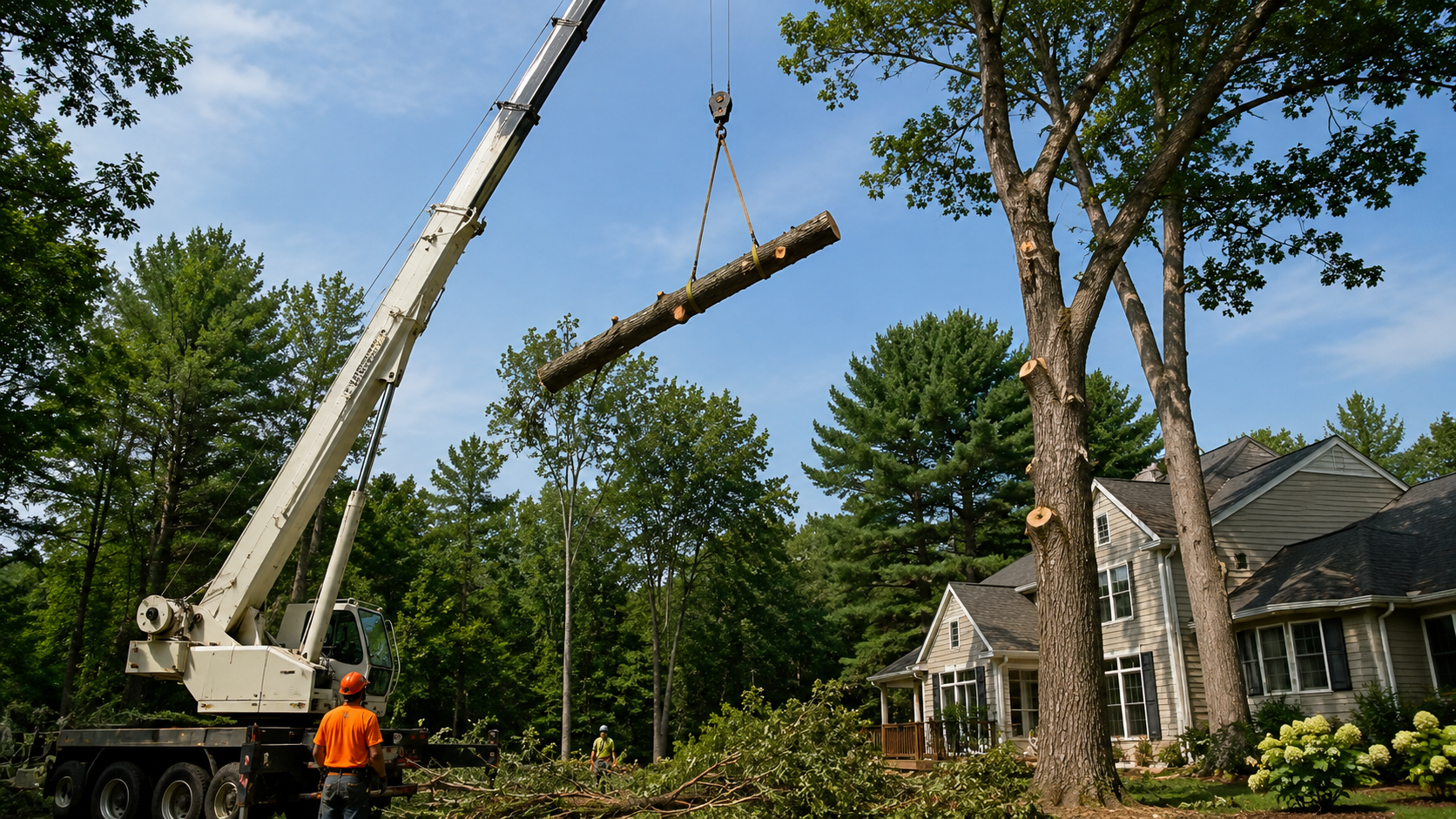
Most tree removals can be completed using conventional sectional dismantling techniques: a climber in the tree, rope rigging, and a ground crew managing the descent of each piece. This approach is highly effective for the majority of residential and commercial tree removal situations and requires no heavy lift equipment beyond a chipper and a truck. But there is a subset of situations where conventional rigging is either not sufficient or not the safest option, and where a crane fundamentally changes what is possible.
Crane-assisted tree removal is not a premium upgrade for trees that could be handled conventionally. It is a practical solution for specific scenarios where the physical constraints of the site or the condition of the tree create risks that rope rigging cannot adequately manage. Understanding when it is genuinely necessary versus when it is being offered unnecessarily helps property owners make informed decisions and understand the higher cost.
Quick Answer: Crane-assisted tree removal is necessary when a tree cannot be safely sectioned using conventional climbing and rigging techniques, typically because there is no safe landing zone for sections, the tree is structurally compromised and unsafe for a climber to ascend, the trunk is too large for efficient sectional removal, or the location requires sections to be lifted clear of structures, fences, or obstacles rather than lowered. The crane allows sections to be lifted out and swung to a processing area that is clear of constraints.
No Safe Fall Zone
The most common reason a crane becomes necessary is the absence of a viable fall zone for any section of the tree. In conventional sectional removal, each cut piece is controlled by ropes and guided to a landing area. That landing area needs to be clear enough for the section to settle without hitting a structure, a fence, a utility line, or a neighbouring tree. When the tree is surrounded on all sides by constraints that prevent any safe landing option, the rope approach does not have a destination for the wood.
In these situations, crane-assisted tree removal changes the equation by lifting sections vertically and then swinging them horizontally to a clear processing area, which might be a truck in the driveway, an adjacent cleared space, or even a neighbouring property where access has been arranged.
City and suburban lots with tight spacing between houses, trees growing in courtyard gardens with no gate access, and trees in the centre of dense plantings where every direction is occupied by other trees or structures are typical examples of environments where the fall zone problem makes crane work necessary.
Structural Compromise of the Tree
A tree with significant internal decay, extensive rot, or structural weakness that makes the trunk unpredictable under cutting pressure presents a risk to any climber who ascends it. Conventional tree removal relies on the tree structure itself to support the climber and the rigging anchor points. When that structure cannot be trusted to hold, climbing the tree becomes unacceptably dangerous.
The risks of DIY hazardous tree removal are highest precisely in these structurally compromised situations, where the behaviour of the tree under cutting is unpredictable and where the consequences of an unexpected failure are severe.
A crane can remove sections from a compromised tree by allowing the operator to attach rigging high in the canopy from the crane arm rather than requiring a climber to ascend to that position. The crane takes the weight of each section before it is cut, which means the risk of an unexpected fall is substantially reduced. This is the method of choice for trees where the structural condition makes any other approach unsafe.
Very Large Trees in Confined Spaces
A mature oak or elm that has grown to significant size in a confined suburban lot presents volume challenges that conventional sectional removal handles less efficiently than a crane. Removing trees near structures of this size requires much smaller sections to keep them manageable on ropes, which means more cuts, more time, and more complexity managing many small pieces around obstacles.
A crane can lift much larger sections, sometimes entire halves of a crown at once, and remove them in far fewer lifts. For a large tree in a constrained space, this significantly reduces the time on site, the number of cuts close to structures, and the overall complexity of the job. The crane cost is often partially offset by the reduction in crew hours that results from more efficient section removal.
Utility Line Proximity
Trees that have grown into or over utility lines present a particular challenge. Depending on the type of line and who owns it, the utility company may need to be involved before any work begins. When lines cannot be de-energised or moved, the removal must work around them without allowing any section to contact the line.
A crane provides the precision to lift sections clear of lines vertically before swinging them away, which gives the crew control over trajectory that rope rigging cannot always provide with the same reliability. This is particularly relevant for distribution lines on the street side of a property where de-energisation requires utility company coordination.
Cost and Why It Is Higher
Crane work costs more than conventional removal because it requires additional equipment with high daily rental or operational costs, a larger crew to manage the crane interaction safely, and more coordination before work begins. The equipment for tree removal specific to crane operations includes the crane itself, specialised rigging straps capable of handling large loads, and sometimes spider lifts or additional machines to assist with access.
The cost premium is real but should be evaluated against what it accomplishes. When crane removal is genuinely necessary, the alternative is either leaving the tree in place or attempting a removal with conventional methods that carry unacceptable risk to the crew, structures, or both. In that context, the cost of the crane is the cost of doing the job safely.
Frequently Asked Questions
How does a crane communicate with the climber during a crane removal?
Crew communication during crane removal uses hand signals, two-way radios, or a combination of both. The climber in the tree, the crane operator, and the ground crew maintain continuous communication throughout each lift. Clear communication protocols are established before work begins and followed precisely during the operation.
Does my neighbour's property need to be involved in a crane removal?
Sometimes. The crane may need to be positioned in a way that requires access to or swinging over an adjacent property, particularly when the driveway or street position does not provide adequate reach. Reputable tree companies identify this during the assessment and arrange any necessary access before the job day.
Can any crane be used for tree removal, or does it need to be a specialist?
Tree removal cranes are operated by certified crane operators and the equipment is selected for the specific lift capacity and reach required by the job. Not every crane is suitable for every tree removal scenario, and the assessment of which crane is appropriate is part of the pre-job planning process.
Is crane removal available for trees in the back garden with no vehicle access?
Yes, though limited access affects how the crane is positioned and what equipment can be used. Spider lifts and compact crane equipment can access areas through narrower gates than a standard crane. Very restricted access may require a combination of equipment and more manual rigging for the sections that the crane cannot directly reach.
How much more expensive is crane removal than standard removal?
Crane removal typically adds $500 to $2,000 or more to the cost of a standard removal, depending on crane size, rental time, and the complexity of the specific job. The total cost depends on the size of the tree, the duration of the crane rental, and the crew time required. Getting a specific quote for the job is the most reliable way to understand the cost.
The Bottom Line
Crane-assisted tree removal is necessary when conventional rigging cannot safely manage the fall zone, when the tree's structural condition makes climbing unsafe, or when the size and location require a lifting approach that ropes alone cannot provide. The higher cost reflects the equipment and coordination required to do the job safely in these conditions.
Sawvell Tree Service performs crane-assisted removals throughout Lake County and the North Shore with experienced operators and appropriate equipment for each situation. If you have a tree that may require crane removal, a site assessment will confirm the right approach.