

How Do Tree Companies Remove Large Trees in Tight Spaces?
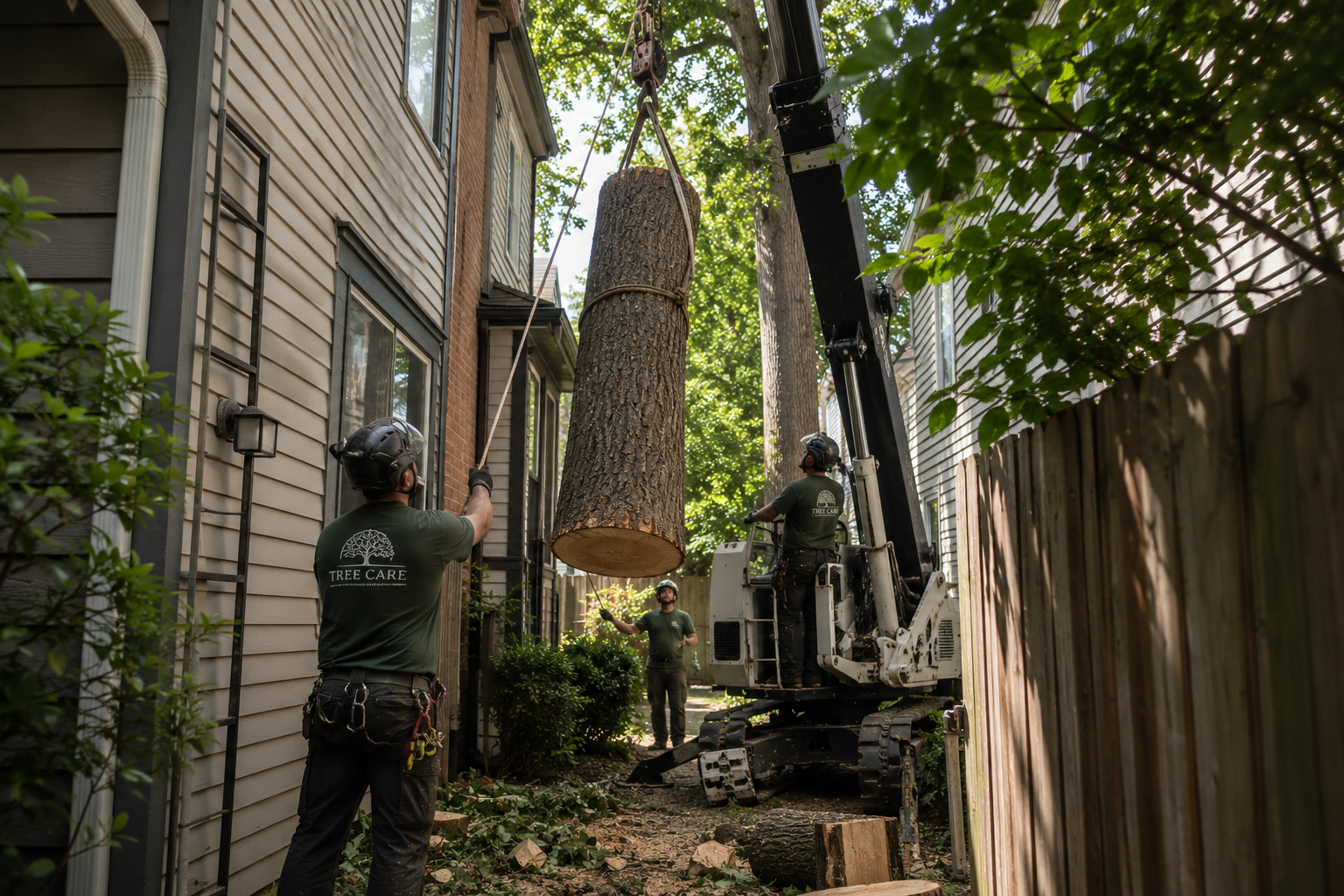
Tree work in Lake County and the North Shore often means working in VERY tight spaces.
Many neighborhoods have:
🌳 Mature trees
🏡 Homes built close together
🚧 Narrow access areas
🔌 Power lines
🌿 Fences, patios, pools, and landscaping nearby
That’s why experience matters.
Not every tree that needs to come down is standing in the middle of an open field. Some of the most challenging removal jobs involve large, mature trees growing between structures, against fences, under power lines, or in densely planted gardens where a conventional fell simply is not an option. These are the situations that separate experienced tree companies from those who can only handle straightforward jobs.
The techniques used to remove large trees in confined spaces have developed significantly over the years, combining rope rigging, specialised climbing, aerial equipment, and where needed, crane technology to safely extract a tree piece by piece without a controlled fall zone. Understanding how these methods work helps property owners know what to expect when they are facing one of these jobs.
Quick Answer: Tree companies remove large trees in tight spaces by dismantling them from the top down, one section at a time. Climbers ascend the tree using ropes and harnesses, cut sections from the crown downward, and use rigging to lower each piece in a controlled manner to the ground crew below. For trees that are too large, too dangerous, or too confined for climbing work, crane-assisted removal lifts entire sections clear of obstacles before they are lowered to a processing area.
Sectional Removal With Rope Rigging
The foundational technique for removing trees in tight spaces is sectional dismantling. A climber ascends the tree using ropes and a harness, typically to the upper crown first. Starting at the top and working downward, sections of the tree are cut and then lowered to the ground using a rigging system: a series of ropes, pulleys, and ground-level rigging points that allow the crew to control the descent of each piece and prevent it from simply dropping.
The key is that nothing falls free. Every cut section is attached to a rigging line before the cut is made. The ground crew controls the load as it descends, guiding it to exactly where they want it to land. Done correctly, a tree can be removed from a space that is only slightly wider than the tree itself without any contact with adjacent structures.
This technique requires a high level of skill from the climber, who must assess each cut, manage their position in the canopy as the tree changes weight distribution with each removal, and communicate precisely with the ground crew throughout. It takes significantly longer than a straightforward fell but is the standard approach for any removal where a clear fall zone does not exist.
Crane Removal for the Most Confined Situations
When a tree is too large for a climber to safely section from within the canopy, when there is significant decay that makes climbing hazardous, or when the space is so confined that even lowered sections have no good landing zone, crane-assisted tree removal is the method that makes the job possible.
A crane is positioned at a point where it can reach the tree and where the boom arm has enough radius to swing removed sections clear of the structure or obstacle. A climber in the canopy attaches rigging straps to a section, the crane takes the load, and the section is lifted clear and swung to a processing area, often on a truck or in an open section of a neighboring lot. The tree effectively disappears from the top down without any of the wood ever touching the ground in the confined space.
The logistics of felling large trees close to structures involve significant planning before the first cut: identifying where the crane can be positioned, calculating the reach needed for the largest sections, planning the swing path to avoid overhead lines, and sequencing the cuts so the tree becomes progressively lighter and more manageable rather than suddenly unstable.
Specialized Equipment That Makes the Work Possible
The ability to work in confined spaces depends heavily on having the right specialized equipment for the task. Rigging blocks and friction devices that can control heavy loads on small diameter ropes, specialised climbing equipment that allows precise positioning in the canopy, compact chippers that can be positioned in tight access, and cranes with sufficient reach all contribute to what is achievable.
Mini-cranes and compact spider lifts have expanded what is possible in particularly restricted access situations, such as gated rear gardens where standard crane equipment cannot reach. These smaller machines have less lift capacity but can navigate through narrow openings and operate in spaces that would defeat larger equipment.
Ground Crew Planning and Communication
The ground crew in a sectional removal is not just moving debris. They are managing the load during the descent of every section, coordinating with the climber on timing and angle, protecting adjacent structures with padding where needed, and ensuring the rigging anchor points are properly placed and maintained throughout the job.
Communication between the climber and the ground crew is continuous during a confined-space removal. Every cut is preceded by confirmation that the rigging is set correctly and the ground crew is ready to receive the load. A breakdown in communication is the most common source of problems in this type of work, which is why experienced teams that have worked together develop shorthand signals and protocols that eliminate ambiguity.
Why This Work Should Not Be Attempted Without Experience
The temptation to save money by attempting removing a large tree yourself is understandable, but confined-space removals are among the highest-risk tree work that exists. A misplaced cut, a rigging failure, or a miscommunication between the person cutting and the person managing the rope can result in a section landing exactly where it should not, with serious consequences for structures or anyone nearby.
The experience required to read a tree under load, anticipate how it will react to each cut, and manage the rigging system to control heavy sections in motion takes years to develop. This is not a situation where watching instructional videos provides adequate preparation.
Even in non-emergency situations, this type of work is often considered a emergency situations given the potential for rapid escalation if something goes wrong near a structure, which is why emergency response capability is a key qualification to look for in any company handling complex removals.
Frequently Asked Questions
Do I need to give the tree company access to my neighbor's property for a crane removal?
Sometimes yes. A crane removal may require positioning the crane on or accessing a section of an adjacent property for the swing arc. An experienced company will identify this in advance, discuss it with you, and may need to communicate with the neighbor to confirm access before the job begins.
How does a company decide between rope rigging and crane removal?
The decision depends on tree size, the condition of the tree (decay affects whether climbing is safe), the available access for crane equipment, and the complexity of the confined space. An experienced arborist will assess all these factors during a site visit and recommend the safest and most practical approach.
Can a large tree be removed if the only access is through a gate?
Yes, though access limitations affect the equipment options. Narrow gate access may rule out standard chippers and limit crane reach. Mini-cranes and compact chippers can navigate tighter access. The assessment will determine what is achievable and whether any temporary access can be created.
Is crane removal more expensive than standard removal?
Yes. Crane rental adds significant cost to any job, and the additional crew and coordination required also contributes to the total. However, for trees where a crane is the safest method, the cost is the appropriate price for doing the job properly without risk to adjacent structures.
How do crews protect structures and plants during a confined removal?
Physical padding on adjacent walls or fences, careful planning of section sizes to stay within the load capacity of the rigging, and precise communication between climber and ground crew are the primary protections. Some companies also use guide ropes to steer sections away from sensitive areas during the controlled descent.
The Bottom Line
Removing a large tree in a tight space is a specialised operation that requires training, experience, proper equipment, and careful coordination. The techniques available to professional crews today make it possible to remove almost any tree regardless of the surrounding constraints.
Sawvell Tree Service handles confined-space and crane-assisted removals across Lake County and the North Shore. If you have a large tree in a difficult location, a site assessment is the starting point for understanding what the right approach looks like.